

Commercial Roofing Systems in North Vancouver: The 2026 Property Manager’s Guide
Most commercial roofing systems in North Vancouver fail at the perimeter long before the membrane itself reaches the end of its life. If you've spent the last rainy season managing emergency leak repairs and juggling conflicting advice on TPO versus torch-on solutions, you aren't alone. It's frustrating to invest in a property only to have the North Shore's extreme rainfall find its way through the seams every winter.
You deserve a roof that offers genuine peace of mind and protection for your tenants. This guide helps you navigate the 2026 BC Building Code requirements and the latest energy efficiency standards to ensure your next project remains leak-free for two decades. We'll explore why combining high-performance SBS membranes with custom-fabricated sheet metal is the most dependable way to lower maintenance overhead and secure your building's structural integrity against our unique coastal climate.
Key Takeaways
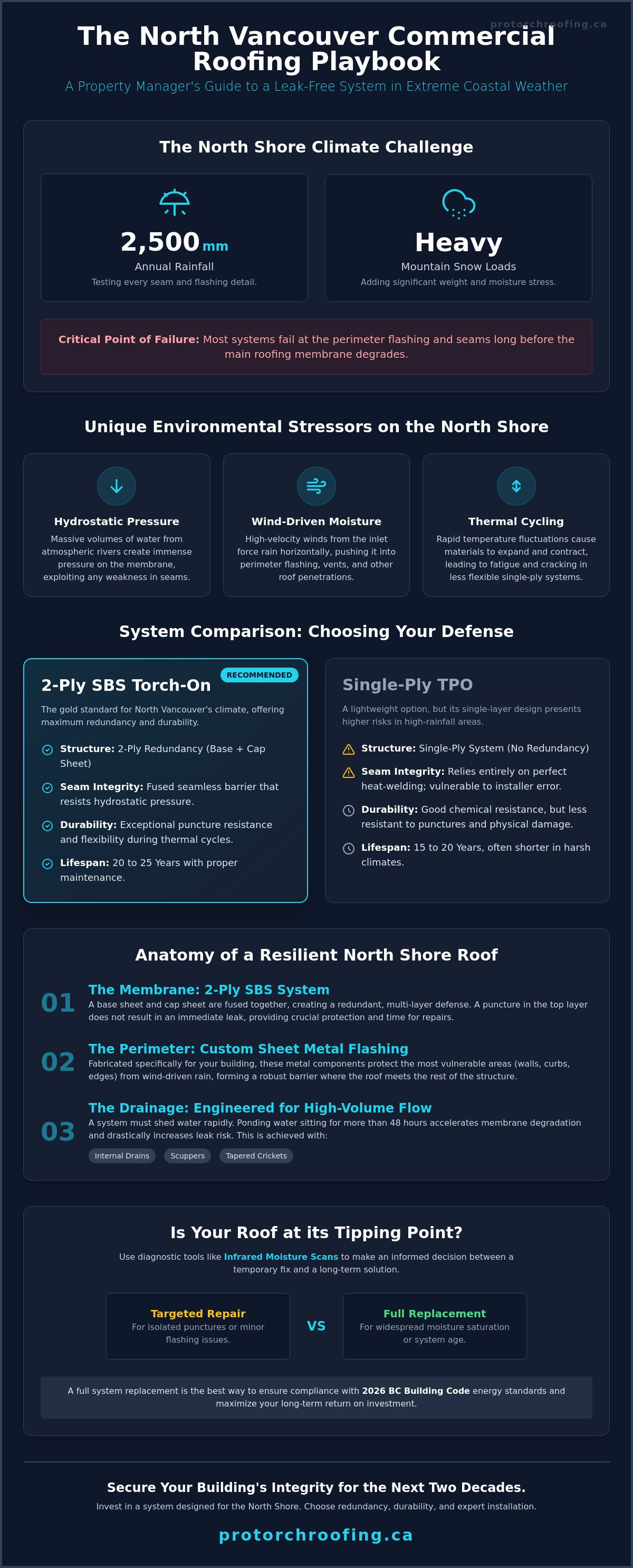
• Learn why SBS Torch-on membranes remain the gold standard for managing North Vancouver’s 2,500mm of annual rainfall and heavy mountain snow loads.
• Discover how to evaluate different commercial roofing systems North Vancouver by comparing initial installation costs against long-term maintenance overhead and ROI.
• Identify the critical "tipping point" for your roof using diagnostic tools like infrared moisture scans to decide between a targeted repair or a full system replacement.
• Ensure your property stays compliant with 2026 BC Building Code energy efficiency standards while maximizing the lifespan of your waterproofing system.
• Understand the importance of custom sheet metal flashing in protecting your building’s perimeter from the unique wind and moisture patterns of the North Shore.
Understanding Commercial Roofing Systems in North Vancouver’s Climate
Commercial roofing systems North Vancouver are more than just a waterproof layer; they're complex, multi-layered assemblies designed to protect flat or low-slope structures from relentless environmental pressure. While a standard specification might work in drier parts of the Lower Mainland, North Vancouver property managers face a different reality. With annual rainfall reaching up to 2,500mm and significant snow loads from the nearby mountains, a "one size fits all" approach often leads to premature failure. A proper understanding of membrane roofing systems is essential for anyone managing assets in neighborhoods like Lonsdale or Deep Cove, where the microclimate demands higher performance standards.
In our experience, 2-ply SBS (Styrene-Butadiene-Styrene) torch-on systems have become the regional standard for modern commercial architecture. These systems utilize a base sheet and a cap sheet, creating a redundant barrier that handles the structural movement common in coastal environments. This redundancy is vital. It provides a safety net against the extreme moisture levels we see on the North Shore, ensuring that a single puncture doesn't immediately result in a tenant dispute or structural damage.
Environmental Stressors Unique to the North Shore
The proximity to the mountains and the Burrard Inlet creates a "pressure cooker" effect for building envelopes. Heavy coastal-mountain downpours increase hydrostatic pressure on the roof surface, testing every seam and flashing detail. Wind-driven rain near the water can force moisture into gaps that would remain dry in a typical storm. Our team frequently identifies several specific stressors that impact commercial roofing systems North Vancouver:
Hydrostatic Pressure
Massive volumes of water resting on the membrane during atmospheric rivers.
Wind-Driven Moisture
High-velocity winds from the inlet pushing rain horizontally against perimeter flashing.
Thermal Cycling
Temperature fluctuations that cause membranes to expand and contract, potentially leading to cracks in less flexible materials.
The Importance of Proper Drainage and Slope
Ponding water is the primary enemy of any flat roof in our region. When water sits for more than 48 hours, it accelerates the degradation of the membrane and increases the risk of a breach. Effective drainage requires more than just a clear pipe. We focus on integrating internal drains and scuppers directly into the roofing system to ensure rapid water shedding. In areas where the roof deck doesn't have a natural fall, we use custom crickets. These are tapered insulation structures that divert water toward the drains, preventing the standing water that plagues so many commercial buildings on the North Shore.
Leading Commercial Roofing Materials for 2026
Selecting the right material for commercial roofing systems North Vancouver requires balancing performance with the specific demands of the 2026 BC Building Code. While several options exist, each material serves a distinct purpose in protecting your building's structural integrity. Compliance with National Research Council Canada's building codes ensures that your chosen system meets the necessary safety and energy efficiency benchmarks for our region. Our focus remains on materials that offer long-term security rather than temporary fixes.
The Resilience of 2-Ply SBS Torch-on Systems
SBS (Styrene-Butadiene-Styrene) torch-on roofing remains the gold standard for the North Shore. It's a modified bitumen system that utilizes a two-ply approach. The base sheet is mechanically fastened or adhered, while the cap sheet is torched on to create a seamless, waterproof barrier. This redundancy is what prevents catastrophic leaks; if the top layer is punctured, the base sheet provides a critical second line of defense. Modern SBS membranes offer exceptional thermal stability, meaning they won't become brittle in the winter or overly soft during summer heat waves. For property managers, this translates to a reliable lifespan of 20 to 25 years when supported by consistent roof maintenance.
TPO (Thermoplastic Polyolefin) serves a different role, particularly for buildings looking to reduce cooling costs through its reflective, "cool roof" surface. It's lightweight and resistant to chemical exposure, making it suitable for specific industrial applications. However, TPO is a single-ply system. Its success relies entirely on expert seam welding. Without precise execution, the seams can become a liability under the constant moisture pressure typical of our coastal environment.
Architectural Metal and Custom Fabrication
Most roof failures in commercial roofing systems North Vancouver occur at the perimeter. Standard, pre-fabricated flashing often fails to create a tight seal against the irregular surfaces of older commercial buildings. We emphasize custom sheet metal work to solve this problem directly. Utilizing heavy-gauge steel that's bent specifically for your building's unique corners and parapets ensures the envelope remains secure. This level of craftsmanship protects against wind-driven rain that standard off-the-shelf components simply can't handle. For sloped commercial structures, standing seam metal roofing provides an elegant, high-durability solution that sheds snow and water effortlessly.
Comparing Systems: SBS Torch-on vs. TPO vs. Metal
Every commercial roofing system presents a different value proposition for property managers. Choosing between commercial roofing systems North Vancouver often comes down to the balance between upfront capital expenditure and the reality of long-term maintenance overhead. While a lower initial bid for a single-ply system might look attractive on a quarterly budget, the North Shore's unique climate often exposes the weaknesses of thinner membranes within the first decade. Understanding how these materials perform side-by-side is essential for making a disciplined, 20-year investment.
Performance Matrix for North Vancouver Buildings
While SBS membranes utilize two layers of reinforced bitumen to resist physical damage, TPO relies on a single thermoplastic layer that is more susceptible to punctures from falling branches or heavy foot traffic. This difference in puncture resistance is critical for buildings located near the heavily treed areas of Upper Lonsdale or Lynn Valley. Seam integrity is another major factor. SBS systems feature torched seams that effectively become a single, monolithic sheet. In contrast, TPO seams are heat-welded; if the welding isn't perfect, standing water can eventually find a path through, especially during the prolonged wet spells common to our region.
Weight matters for older buildings. TPO is the lightest option, making it a frequent choice for structures with limited load-bearing capacity. Metal roofing is exceptionally durable and sheds snow effortlessly, but it requires a specific structural slope to be effective. For the majority of flat-roofed commercial buildings in North Vancouver, the 2-ply SBS system provides the best balance of weight, durability, and ease of repair. If a leak does occur, SBS is very "patch-friendly," allowing for simple, localized repairs that bond perfectly to the existing membrane.
ROI and Total Cost of Ownership
A building's roof is a significant line item in a strata or corporation's reserve fund study. Investing in a robust system can often lead to more favorable terms from insurers who recognize the reduced risk of water damage claims. Beyond insurance, the value of transferable warranties shouldn't be overlooked. A high-quality installation with a documented maintenance history adds tangible value during property divestment, ensuring the roof is seen as an asset rather than a looming liability for a potential buyer.
Cheap bids hide future costs. We've seen many property managers choose the lowest-cost installation only to face emergency repair bills within five years. When you calculate the total cost of ownership over ten years, a premium SBS system often proves to be the more economical choice. It meets the 2026 "cool roof" standards for energy efficiency while providing the structural integrity needed to withstand North Vancouver’s relentless coastal-mountain weather. This peace of mind is what ultimately protects your bottom line and your tenants' safety.
Evaluating Your Roof: Repair, Restore, or Replace?
Deciding whether to patch a leak or invest in a full replacement is one of the most challenging decisions for a property manager. For commercial roofing systems North Vancouver, the constant exposure to high precipitation means that even a minor breach can quickly saturate the underlying insulation. We use advanced diagnostic tools to remove the guesswork from this process. Infrared moisture scans allow us to see through the membrane and identify trapped pockets of water that aren't visible to the naked eye. Core sampling further confirms the condition of the deck and vapor barrier; this provides a clear picture of whether the system's foundation is still sound.
Strategic replacement planning is essential as we move through 2026. With labor costs and material standards evolving under the latest BC Building Code, waiting for a catastrophic failure usually results in higher emergency fees and tenant disruptions. By assessing your roof's condition during the dry summer months, you can budget for capital expenditures more effectively and avoid the stress of a mid-winter crisis. A methodical assessment today prevents a financial emergency tomorrow.
The 20% Rule for Commercial Roof Repair
We generally advise property managers to follow the 20% rule. If the estimated cost of a commercial roof repair exceeds 20% of the total system replacement value, it's time to consider a full upgrade. This is especially true if the underlying insulation is compromised. Wet insulation loses its R-value and can lead to mold growth or deck rot. For sensitive commercial tenants like medical clinics or high-end retail, the risk of a repeat leak often outweighs the temporary savings of a patch. Protecting the tenant experience is just as important as protecting the physical structure.
Commercial Roof Maintenance Programs
The longevity of your investment depends heavily on preventative roof maintenance. North Vancouver’s heavy storm cycles bring down debris that can clog internal drains and scuppers in a single afternoon. When drains are blocked, water backs up and increases the weight load on your structure, creating hydrostatic pressure that forces water into the seams. We recommend semi-annual inspections to clear these pathways and check perimeter flashing for wind damage. This simple step is the most effective way to avoid major system failures.
A proactive approach keeps small issues from becoming capital-intensive projects. If you're unsure about the current health of your building's envelope, you can schedule a professional assessment to get a detailed report on your roof's remaining service life and ensure your commercial roofing systems North Vancouver remain in peak condition.
Why Pro Torch is the North Vancouver Commercial Standard
For over 25 years, our family-owned team has specialized in protecting the building envelopes of the Lower Mainland. We understand that commercial roofing systems North Vancouver require a disciplined approach that goes beyond standard installation. Our commitment to transparent communication means you receive honest assessments of your roof's health, rooted in decades of local experience. We don't believe in high-pressure sales; instead, we focus on providing the structural integrity and security your business needs to thrive in our coastal environment. It's about providing genuine peace of mind for property managers who can't afford the downtime of a major leak.
A major advantage we offer is our in-house custom sheet metal shop. As we've discussed throughout this guide, most leaks begin at the perimeter where pre-fabricated components fail to create a perfect seal. By fabricating our own heavy-gauge flashing and drainage components, we ensure a bespoke fit for every parapet, corner, and penetration on your building. This level of craftsmanship is essential for managing the high-volume runoff and wind-driven rain unique to the North Shore. We take pride in being a local British Columbia business that understands the specific demands of our neighborhood architecture.
Our Local Expertise and Craftsmanship
Our technicians are specifically trained in the application of high-performance SBS membranes, ensuring every seam is monolithic and waterproof. We stay current with the specific building codes and bylaws of both the City and District of North Vancouver, ensuring your project remains compliant with 2026 standards. Our expertise in torch-on roofing allows us to handle complex commercial geometries that other contractors might struggle to seal correctly. It's a methodical rhythm of protection that secures your asset for the long term.
Get a Professional Assessment for Your Building
If you're managing a property on the North Shore, you need a clear roadmap for your capital expenditures. A Pro Torch commercial roof audit provides exactly that. We perform a comprehensive evaluation, including moisture scans and flashing inspections, to identify potential vulnerabilities before they become emergencies. You'll receive a detailed report with transparent budgeting options for your 2026 projects. This allows you to make informed decisions for your strata or corporation without the guesswork.
Don't wait for the next atmospheric river to test your building's defenses. Our team is ready to provide the specialized regional knowledge required to keep your property dry and secure. Contact Pro Torch Roofing for a Commercial Quote today to ensure your commercial roofing systems North Vancouver are engineered for the long-term health of your property and the safety of your tenants.
Secure Your Property Against the North Shore's 2026 Climate
Managing commercial roofing systems North Vancouver requires a disciplined strategy that balances modern building codes with the reality of heavy annual rainfall. We've seen that the most resilient buildings combine 2-ply SBS membranes with custom-fabricated perimeter flashing to stop leaks before they start. By choosing materials with high thermal stability and prioritizing regular maintenance, you protect your tenants and your long-term ROI. A proactive approach to your roof today ensures your building remains a secure asset for decades.
Pro Torch Roofing brings over 25 years of specialized experience to every project. Our A+ BBB rating and in-house custom sheet metal shop ensure your building's envelope is handled with the highest level of craftsmanship. We focus on transparency and structural integrity so you don't have to worry about the next storm cycle. Our goal is to provide the security and peace of mind that comes from a job done right the first time.
Request a Professional Commercial Roofing Assessment today to get a clear, expert perspective on your building's health. We're here to provide the dependable protection your North Vancouver asset deserves.
Frequently Asked Questions
What is the best commercial roofing system for North Vancouver?
A 2-ply SBS torch-on system is widely considered the superior choice for commercial roofing systems North Vancouver. Its redundant layers provide a higher level of protection against the 2,500mm of annual rainfall we experience on the North Shore. This system offers the structural integrity needed to handle mountain snow loads while remaining flexible during the temperature shifts common in our coastal environment.
How much does a commercial roof replacement cost in 2026?
Costs for a commercial replacement in 2026 depend on several variables, including the total square footage, the complexity of the roofline, and the condition of the existing deck. While prices vary across the industry, property managers should prioritize the total cost of ownership over the lowest initial bid. Factors like insulation upgrades required by the 2024 BC Building Code will also influence the final investment.
How long does a torch-on roof last in the Vancouver climate?
A high-quality torch-on roof typically lasts between 20 and 25 years in the Vancouver climate. Longevity depends heavily on the quality of the initial installation and the consistency of your professional maintenance program. Regular clearing of debris and inspections of perimeter flashing ensure the SBS membrane remains waterproof and secure throughout its entire expected service life.
Can you install a new commercial roof over an existing one?
While "re-roofing" or installing a new membrane over an old one is technically possible in some cases, it's rarely recommended for North Vancouver buildings. Trapping moisture between layers can lead to deck rot and the premature failure of the new system. Most professional assessments will suggest a full tear-off to ensure the underlying structure is sound and compliant with 2026 energy standards.
What are the signs that my commercial roof needs immediate repair?
Immediate signs of trouble include standing water that doesn't drain within 48 hours, visible blisters in the membrane, and interior water stains on ceilings or walls. You should also watch for loose perimeter flashing or gaps in the seal around HVAC units. if you notice any of these issues, it's vital to seek a professional assessment to prevent long-term structural damage to the building.
Is TPO or Torch-on better for North Vancouver buildings?
For most North Vancouver commercial buildings, 2-ply SBS torch-on is the better option due to its multi-layered redundancy and superior puncture resistance. TPO is a lightweight, reflective alternative that can help lower energy costs, but it lacks the secondary barrier that makes SBS so dependable in our high-moisture coastal-mountain environment. SBS systems generally provide better peace of mind for local property managers.
Does Pro Torch Roofing offer emergency commercial repairs?
Yes, Pro Torch Roofing provides professional repair services for commercial properties across the Lower Mainland. Our team focuses on identifying the root cause of a leak and providing a technical remedy that restores the safety and security of your building. We prioritize quality craftsmanship to ensure that a localized repair doesn't become a recurring problem for your tenants or your maintenance budget.
How often should a commercial flat roof be inspected on the North Shore?
Commercial flat roofs on the North Shore should be inspected at least twice a year, ideally in the spring and fall. These inspections are critical for clearing drains and scuppers before the heavy winter rains begin. We also recommend a quick assessment after major wind or snow events to ensure that perimeter flashing hasn't been compromised by falling branches or storm debris.
