

Early Warning Signs of Roof Damage in North Vancouver: The 2026 Homeowner’s Guide
Last November, a Lynn Valley resident watched a minor damp spot on their ceiling transform into a major restoration project after a single night of 65mm rainfall. It's a scenario that plays out across the North Shore every winter because the most dangerous signs of roof damage North Vancouver properties face are often invisible from the street level. You likely already feel that our heavy tree cover and persistent coastal rain create a unique set of challenges for your home's structural integrity.
We understand that the anxiety of being overcharged by contractors often leads to delayed maintenance, but protecting your investment shouldn't be a guessing game. This 2026 guide provides the clear criteria you need to distinguish between simple moss growth and critical failures in your SBS membranes or perimeter flashing. We'll outline a professional maintenance plan designed to survive the harshest BC winters and give you the confidence to choose a local expert who prioritizes long-term security and transparent communication over high-pressure sales tactics.
Key Takeaways
• Understand how the unique "Mountain Effect" and heavy North Shore rainfall accelerate roof aging compared to other Lower Mainland areas.
• Learn to identify the specific signs of roof damage North Vancouver homeowners often overlook, such as shingle granule loss and perimeter flashing vulnerabilities.
• Discover why interior red flags like musty attic odors or bubbling paint are critical indicators of ventilation failure and moisture intrusion.
• Master the "25% Rule" to determine whether a targeted repair or a full replacement provides the best long-term protection for your property.
• Gain peace of mind by learning the difference between a basic visual check and a professional assessment backed by 25+ years of local BC expertise.
The North Shore Microclimate: Why Roofs Fail Faster in North Vancouver
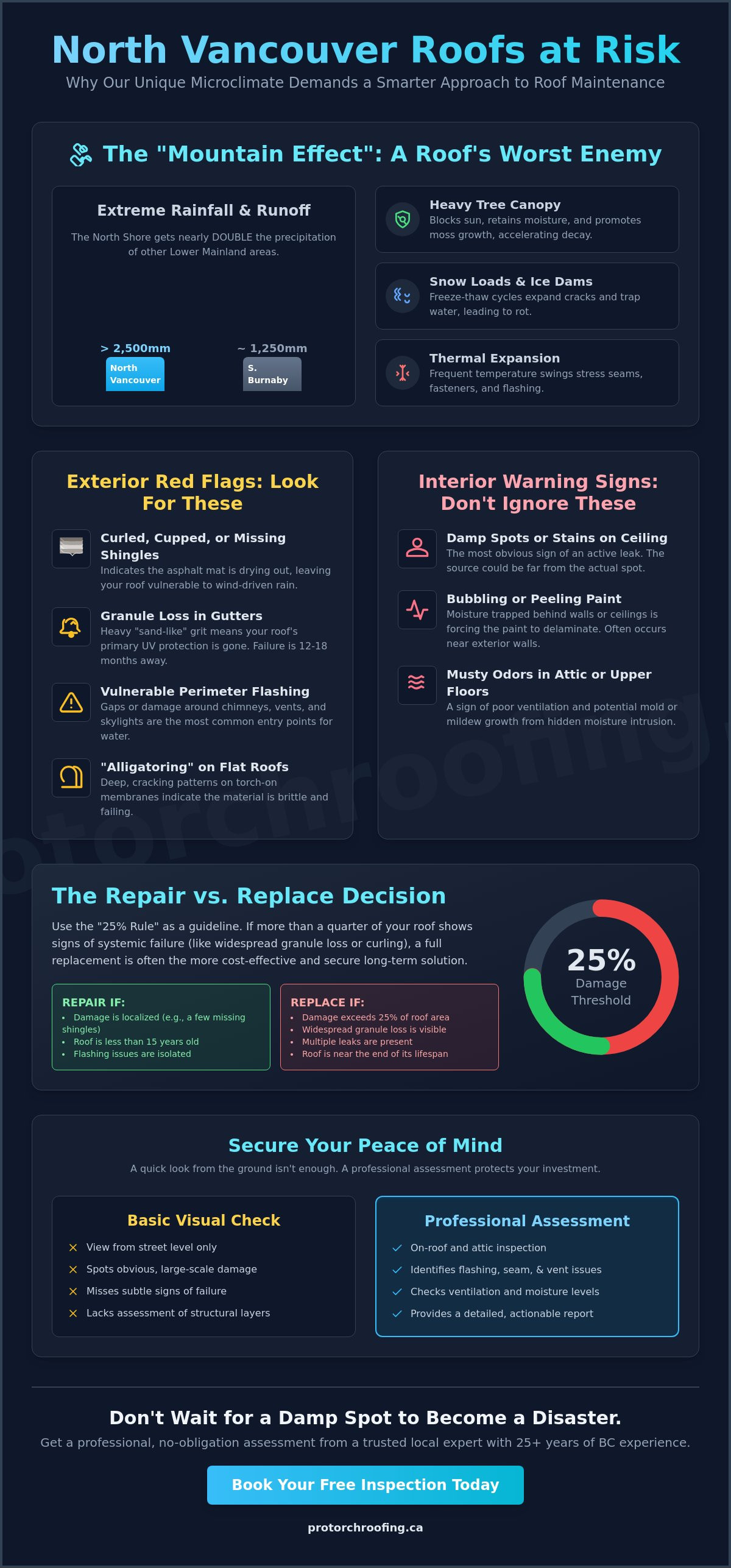
North Vancouver's geography creates a unique set of challenges for residential and commercial structures. While the Lower Mainland generally shares a temperate climate, the North Shore experiences a localized "Mountain Effect" that accelerates the aging process of building materials. Homeowners in Lynn Valley and Upper Lonsdale often see signs of roof damage North Vancouver residents in flatter areas like Richmond might not encounter for another decade. This is largely due to orographic lift, where the mountains force moist Pacific air upward, cooling it and triggering intense precipitation directly over our neighborhoods.
The proximity to the mountain peaks means temperature swings are more frequent and extreme than in the valley. This causes rapid thermal expansion and contraction. Over time, this movement stresses the seams and fasteners of your roofing system. If your perimeter flashing isn't secured with expert craftsmanship, these cycles will eventually create gaps where moisture can seep in. This constant mechanical stress, combined with the corrosive nature of salt air from the Burrard Inlet, leads to premature roof failure that compromises the safety of your home.
The Impact of Excessive Rainfall and Mountain Runoff
With over 2,500mm of annual rainfall, North Vancouver receives nearly double the precipitation of South Burnaby. This volume puts immense stress on roof maintenance protocols. During atmospheric river events, hydrostatic pressure can force water under shingles or behind flashing if the installation lacks precision. Often, drainage systems like gutters and scuppers fail first because they can't handle the massive mountain runoff, leading to water backing up into the roof's structural layers. Identifying these signs of roof damage North Vancouver early is the only way to prevent costly interior repairs.
Heavy Tree Canopies and Moisture Retention
The heavy tree canopies in neighborhoods near the forest line create a persistent damp environment. These trees block sunlight, preventing roofs from drying out and encouraging moss and lichen growth. This moisture retention breaks down the protective granules on your roof surface. We often see asphalt shingle decay manifest as curling, brittle edges, or deep staining much earlier than the manufacturer's warranty suggests. For properties under heavy shade, the lack of airflow means your roof stays saturated for months at a time, rotting the plywood decking beneath the surface.
Heavy Snow Loads and Freeze-Thaw Cycles
North Shore properties endure significantly heavier snow loads than the rest of the Lower Mainland, which creates risks for ice damming on sloped surfaces. When snow melts and refreezes at the eaves, it creates a barrier that traps liquid water on the roof. This water eventually finds its way under the shingles, where it can rot the fascia and soffits. Freezing water expands cracks in aged asphalt shingles. As a local expert, ProTorch Roofing recommends regular inspections to ensure your structural integrity remains intact before the winter freeze sets in.
Visible Exterior Red Flags: From Shingle Decay to Flat Roof Failures
North Vancouver receives an average of 160 days of precipitation annually. This consistent moisture puts immense pressure on your home's exterior envelope. Identifying the early signs of roof damage North Vancouver homeowners face is the first step toward maintaining long-term security. When you inspect your roof from the ground or a ladder, look for missing, curled, or "cupped" shingles. These distortions happen when the asphalt mat dries out, often due to high UV exposure or poor attic ventilation. If your shingles look like they are shrinking or turning upward at the corners, they can no longer deflect wind-driven rain.
Check your gutters for "bald" shingles. If you find sand-like grit or heavy accumulations of granules in the downspouts, your roof is losing its primary layer of defense. Granules protect the underlying bitumen from sun damage; without them, the roof will brittle and crack within 12 to 18 months. For commercial or modern residential properties, torch-on roofing requires a different inspection protocol. Look for "alligatoring," which is a pattern of deep cracks that resemble reptile skin. This indicates the membrane has lost its elasticity and is nearing the end of its functional life.
Asphalt Shingle and Cedar Shake Vulnerabilities
Heat buildup in your attic can cause "clawing," where the center of the shingle arches upward while the edges stay flat. This often occurs when attic temperatures exceed 65 degrees Celsius during the summer months. In humid North Shore pockets like Deep Cove, cedar shakes are particularly vulnerable to rot. Look for dark, soft wood or splits that run the full length of the shake. You should also watch for "shiners," which are nails that were driven incorrectly or have backed out. These exposed metal points act as tiny conduits, allowing water to bypass the shingle and rot the roof decking over a 2 to 3 year period.
Flat Roof and SBS Membrane Distress Signals
Blisters or bubbles in a torch-on system suggest that moisture was trapped between the layers during installation or has seeped in through a puncture. When the sun heats the roof, this moisture expands and stretches the SBS membrane. You must also examine the perimeter flashing. A gap as small as 2mm is enough to invite water behind the membrane during a typical North Vancouver windstorm. The most critical emergency signal is ponding water. If water remains on a flat roof for more than 48 hours after a storm, the weight creates structural stress and increases the risk of a catastrophic interior leak.
If you spot any of these red flags, a professional assessment can help you determine if a localized repair is possible before the damage spreads to your home's interior.
Interior Warning Signs: Tracking Moisture Before It Becomes a Flood
Interior issues often signal that a breach has existed for months. In North Vancouver, where annual rainfall often exceeds 2,500mm, moisture doesn't just sit; it migrates. If you notice yellow or brown rings on your ceiling, or if your paint begins to bubble and sag, you're looking at a late-stage failure. These are critical signs of roof damage North Vancouver homeowners shouldn't ignore. A musty, earthy smell when you open the attic hatch is another red flag. This scent usually indicates inadequate roof ventilation, which traps humid air against your structural timbers and accelerates rot.
Attic Inspections: What to Look for Under the Rafters
Your attic provides a clear history of your roof’s health. Examine your insulation first. If the "pink stuff" looks matted, compressed, or shows dark spots, it has likely absorbed slow seepage over several seasons. Look at the underside of the roof deck for dark streaks or black mould growth. This is where capillary action comes into play. Capillary action is the ability of a liquid to flow in narrow spaces without the assistance of, or even in opposition to, external forces like gravity, which pulls water uphill into North Van attics through tiny shingle gaps.
Attic Rain
This is condensation that occurs when warm house air hits a cold roof deck. It mimics a leak even if the shingles are intact.
Daylight Streaks
If you see pinpricks of light through the roof boards, your shingles or underlayment have failed. This is an immediate call-to-action for expert roof repair to prevent structural collapse.
Wall and Ceiling Indicators in Living Spaces
Detecting the source of moisture requires a bit of detective work. If a stain appears only after a heavy North Shore downpour, it's a roofing issue. If the dampness is constant regardless of weather, it's likely plumbing. Look closely at where your walls meet the ceiling. Peeling wallpaper or cracked paint in these corners often signals a failure in your perimeter flashing or SBS membrane seal.
Beyond visible water, your utility bills tell a story. A 15% spike in heating costs during the winter months of 2025 could indicate that saturated insulation has lost its R-value. Sudden drafts in upper-floor rooms are another sign that your building envelope is compromised. These subtle shifts are often the most reliable signs of roof damage North Vancouver residents can track before a minor drip becomes a major flood. Our team recommends a professional inspection if you notice any changes in your home's humidity levels or thermal performance.
The Repair vs. Replace Decision: A Homeowner’s Framework
Deciding whether to patch a leak or invest in a full replacement is a pivotal moment for any property owner. In North Vancouver, where annual rainfall often exceeds 2,500mm, the environmental pressure on your home is relentless. Identifying the signs of roof damage North Vancouver homeowners typically face requires a methodical approach to cost and longevity. Most standard asphalt shingles in our BC climate begin to fail after 17 to 20 years. If your roof is approaching this age, minor repairs often become a temporary fix for a systemic problem.
Our team utilizes the "25% Rule" to provide clarity. If the cost of a professional repair exceeds 25% of the total replacement value, the investment shifts from maintenance to a diminishing return. Relying on "patchwork" solutions can be dangerous; multiple layers of mismatched materials often trap moisture and compromise the structural integrity of the underlying decking. For those looking for a permanent solution to the North Shore's heavy snow and rain, modern metal roofing offers a 50-year lifespan that eliminates the cycle of frequent repairs.
When a Professional Repair is the Logical Choice
Repairing your roof is the most sensible path when the damage is localized and the rest of the system remains healthy. If a single windstorm or a fallen branch from a Douglas Fir has dislodged a few shingles, a targeted fix restores protection without the need for a full overhaul. We often see flashing failure around chimneys or skylights while the primary field of the roof is in excellent condition. In these cases, resealing the perimeter flashing or clearing minor gutter-related backups can extend the life of your roof by several years without breaking your budget.
Signs That a Full Roof Replacement is Unavoidable
When the signs of roof damage North Vancouver homes exhibit become widespread, replacement is the only way to ensure safety. You should look for these critical indicators:
Widespread Granule Loss
If your gutters are filled with sand-like sediment, your shingles have lost their UV protection and are now brittle.
Systemic Leaks
Active water ingress appearing in multiple rooms suggests the waterproof membrane has failed across the entire structure.
Structural Sagging
Visible dips in the roofline often indicate that moisture has caused rot in the plywood sheathing or rafters.
Ignoring these signs can lead to mold growth and expensive interior damage. A proactive replacement with high-quality SBS membranes or metal systems ensures your home remains a dry, secure sanctuary for decades to come.
Protect your home with a detailed assessment from a local expert. Contact ProTorch Roofing today for a professional evaluation of your roof’s health.
Securing Your Peace of Mind: Professional Inspections in North Vancouver
Identifying the early signs of roof damage North Vancouver homeowners face requires more than a quick glance from the driveway. While a handyman might offer a casual "peek," Pro Torch Roofing provides a forensic assessment. We examine every component, from the structural integrity of your decking to the condition of your SBS membranes and perimeter flashing. Our transparent reporting includes high-resolution photos and thermal imaging data, so you see exactly what our technicians see. This methodical approach catches moisture trapped beneath the surface before it manifests as a costly interior leak.
Our team brings 25+ years of local British Columbia experience to every project. This longevity is vital when navigating the specific building codes of the North Shore, which are designed to handle extreme environmental loads. We don't just look for current leaks; we evaluate the longevity of your entire system. Preventative maintenance and professional oversight can save property owners over $10,000 in emergency restoration and premature replacement costs over a ten-year period.
Why Local Expertise Matters for North Shore Homes
North Vancouver's climate is notoriously unforgiving, with some areas receiving over 2,500mm of annual precipitation. This volume requires specialized drainage and runoff solutions that standard roofing packages often ignore. We utilize custom sheet metal work to manage water flow on the unique West Coast architectural designs found throughout the region. Our deep understanding of municipal requirements ensures your roof remains compliant and functional. Pro Torch provides a "peace of mind" guarantee that prioritizes the long-term safety and structural integrity of your home.
Next Steps: Booking Your 2026 Roof Assessment
Preparation is key for an accurate 2026 estimate. Before our arrival, please ensure our team has clear access to the roof perimeter and gather any history of past leaks or repairs. We prioritize safety and professionalism in every interaction. Our crew maintains full WCB coverage and specialized liability insurance for the steep-slope work common in North Vancouver. Following these steps ensures a smooth process:
Clear access
Remove vehicles or obstacles from the driveway for ladder placement.
Leak history
Note the dates and locations of any previous moisture ingress.
Documentation
Review our detailed report to understand the recommended timeline for repairs.
Don't wait for a storm to reveal a weakness in your home's primary defense. A proactive assessment is the most effective way to extend the life of your torch-on or shingle system. Schedule your professional North Vancouver roof inspection with Pro Torch Roofing today.
Securing Your North Vancouver Home for 2026 and Beyond
North Vancouver receives between 1,600mm and 2,500mm of annual precipitation, making your roof the primary defense against relentless coastal moisture. Identifying the early signs of roof damage North Vancouver homeowners often overlook, like granule loss or compromised perimeter flashing, prevents minor leaks from becoming expensive structural failures. Whether you're managing a flat roof with SBS membranes or a sloped system, proactive maintenance is the only way to ensure your property remains a safe haven.
Pro Torch Roofing brings over 25 years of local BC roofing experience to every project. As a family-owned business, we specialize in high-performance torch-on systems and custom sheet metal work designed for our specific climate. We focus on disciplined craftsmanship to extend the longevity of your property. Don't wait for a storm to test your home's structural integrity. Protect your home from the North Shore elements: request a professional roof assessment from Pro Torch Roofing today. Your peace of mind is our priority; we're here to help you build a safer future for your home.
Frequently Asked Questions
How much rainfall can a North Vancouver roof typically handle before failing?
A North Vancouver roof is engineered to manage an average of 2,522 millimeters of annual precipitation. This high volume requires a perfectly sealed system to prevent water ingress. If your SBS membranes or shingles show signs of roof damage North Vancouver homeowners often overlook, like curling or cracking, the system can fail during a single high-intensity storm event. Maintaining structural integrity ensures your home stays dry during the 160 rainy days we experience each year.
Is moss growth on my North Shore roof just a cosmetic issue?
Moss growth is a structural threat because it retains up to 10 times its weight in water against your roofing material. This constant moisture accelerates the decay of shingles and can lead to wood rot in the underlying deck. In our humid North Shore climate, moss roots can lift shingles, creating gaps for leaks. We recommend professional removal to protect your roof's longevity and prevent premature failure of the building envelope.
What are the most common causes of flat roof leaks in North Vancouver?
The primary causes of flat roof leaks are ponding water and compromised perimeter flashing. When water sits for more than 48 hours, it puts immense pressure on the torch-on system. Debris from nearby hemlock and cedar trees often blocks drains, leading to 70 percent of the leaks we see in local residential properties. Regular maintenance of your SBS membranes prevents these avoidable structural issues.
Can I repair just one section of my roof, or do I need a full replacement?
You can often repair a single section if the damage affects less than 25 percent of the total roof area. If the rest of the system is structurally sound, a targeted patch or membrane replacement provides a cost-effective solution. However, if signs of roof damage North Vancouver residents notice are widespread, a full replacement is safer. We assess the age and condition of your entire system to ensure a repair won't just hide a larger problem.
How often should I have my roof inspected in the Lower Mainland climate?
You should schedule a professional roof inspection twice per year, ideally in the spring and fall. The Lower Mainland's heavy rainfall and freeze-thaw cycles can cause small cracks to expand quickly. Regular checkups allow us to identify minor issues with your perimeter flashing or sealants before they become expensive emergencies. This proactive approach extends the lifespan of your roof by 5 to 10 years.
Does home insurance typically cover roof damage from heavy BC rain?
Home insurance typically covers sudden, accidental damage from wind or fallen branches, but it rarely covers leaks caused by gradual wear and tear. Most policies require homeowners to maintain their property to a reasonable standard. If a leak occurs because you didn't address 10 years of aging, the claim might be denied. Review your specific policy details to understand your coverage limits for weather-related events.
What is the best roofing material for homes near the North Shore mountains?
High-quality SBS torch-on membranes are the most reliable choice for flat or low-slope homes near the North Shore mountains. These systems offer superior flexibility and can withstand the 30-degree temperature swings common in our alpine environment. For sloped roofs, heavy-weight architectural shingles provide the necessary wind resistance. Both options ensure long-term protection against the high humidity and heavy snow loads found in higher elevations.
How do I know if my gutters are the cause of my roof damage?
You can identify gutter-related damage by checking for water stains on your fascia boards or dampness in your attic's soffit area. When gutters clog, water backs up under the edge of your roofing material, causing the wood to rot. If you see water cascading over the sides during a 20-millimeter rainfall, your drainage system is failing. Keeping gutters clear is essential to prevent water from bypassing your roof's primary defense layers.
