

Roofing and Flashing: The Essential Guide to Protecting Your Vancouver Home
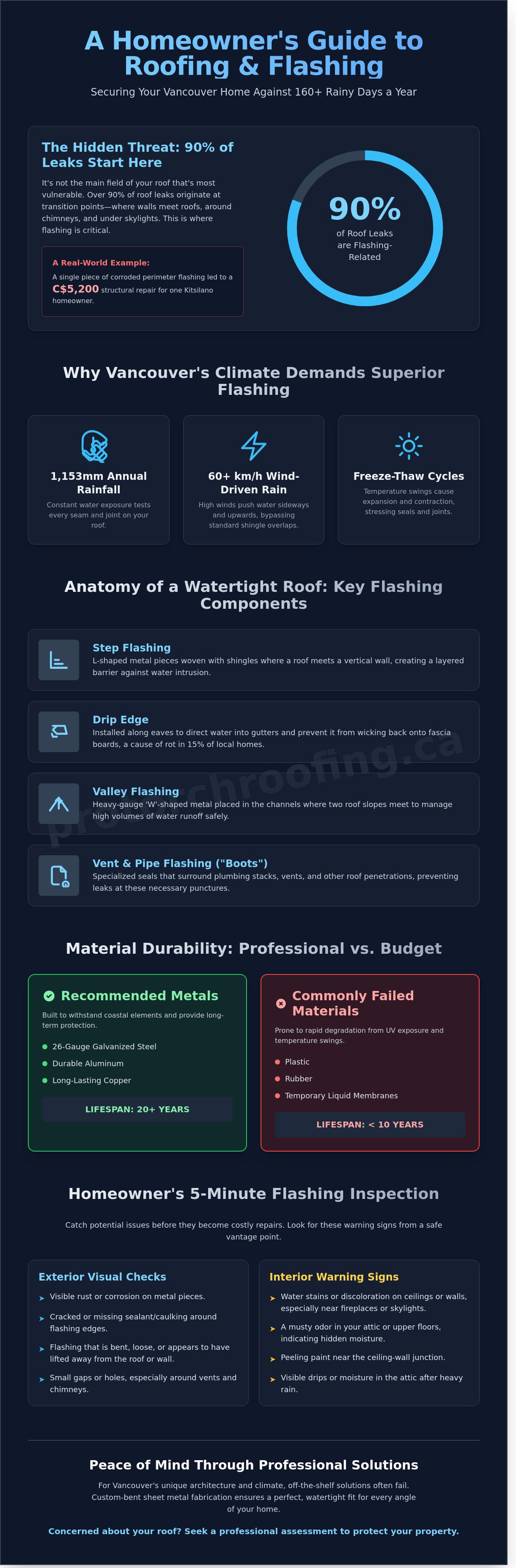
Last November, a Kitsilano homeowner noticed a small water stain near their chimney that quickly escalated into a C$5,200 structural repair. This damage didn't happen because the shingles failed; it happened because a single piece of perimeter flashing had corroded over time. You likely already realize that living in a region with over 160 rainy days a year requires a robust system of roofing and flashing to stay dry. It's stressful to worry about hidden rot or recurring leaks near skylights, especially when technical terminology feels confusing and the threat of water ingress feels constant.
This guide will teach you exactly how these components work together to provide a secure, watertight seal against the Lower Mainland's coastal elements. You'll learn to identify the specific materials like SBS membranes and galvanized steel that maintain the structural integrity of British Columbia homes. We will walk through the common signs of failure and provide a clear timeline for when you should seek a professional assessment to protect your property's long term health and your own peace of mind.
Key Takeaways
• Understand why the relationship between your primary roofing materials and metal flashing is the foundation of a truly waterproof building envelope.
• Identify how the Lower Mainland’s salt air and temperature swings cause thermal expansion, stressing your joints and leading to potential leaks.
• Learn visual inspection techniques and interior warning signs to detect vulnerabilities in your roofing and flashing before they compromise your structural integrity.
• Discover why custom-bent sheet metal fabrication provides a superior fit for Vancouver’s unique architecture compared to off-the-shelf solutions.
• Gain the peace of mind that comes from knowing exactly which components, like drip edges and step flashing, are essential for protecting your eaves and fascia.
Understanding Roofing and Flashing: Your Home’s First Line of Defense
Your roof's primary material, whether it's a high-performance SBS torch-on membrane or traditional shingles, provides the bulk of your home's protection. However, the synergy between roofing and flashing is what actually secures your building envelope. Flashing acts as the primary seal at every joint, valley, and penetration. It's widely recognized in the industry that over 90% of roof leaks originate at these transition points rather than in the field of the roof itself. Without precise flashing, even the most expensive roofing material will fail at the seams.
The physics of a waterproof home relies on effective water shedding. Flashing utilizes gravity to direct runoff away from structural gaps and into the gutter system. According to the BC Building Code Section 9.26.4, proper roof-to-wall transitions must include specific overlaps and heights to prevent moisture from entering the wall assembly. This regulation ensures that Vancouver homes maintain their structural integrity despite our heavy coastal moisture levels. When these transitions aren't managed correctly, water finds its way into your insulation and framing, leading to costly rot.
What Exactly is Roof Flashing?
Roof flashing is a weather-resistant barrier installed at roof intersections and transitions to redirect water away from vulnerable seams. While some budget contractors use plastic or rubber, these materials often degrade within 10 years due to UV exposure and temperature swings. We utilize durable metals like 26-gauge galvanized steel, aluminum, or copper to ensure long-term craftsmanship. These metal components are essential for preventing "wicking," a process where water travels upward between tight surfaces through capillary action. By creating a physical break, metal flashing keeps your substrate dry and secure.
Why Vancouver Homes Need Specialized Flashing
Vancouver receives an average of 1,153mm of annual rainfall, making water management a constant challenge for property owners. Standard shingle overlaps often fail to withstand the wind-driven rain coming off the Georgia Strait, which can push moisture horizontally at speeds exceeding 60 km/h. In the Lower Mainland, we prioritize mechanical flashing systems over temporary liquid membranes. Mechanical flashing provides a permanent physical shield that doesn't peel or crack during our frequent freeze-thaw cycles. This disciplined approach to roofing and flashing is the only way to guarantee peace of mind during a typical British Columbia winter.
The Critical Types of Roof Flashing Used in Burnaby and Vancouver
Every home in the Lower Mainland faces a unique battle against 1,153mm of average annual rainfall. To win this battle, your roofing and flashing must work as a unified system. Flashing acts as the primary defense for the most vulnerable areas of your structure, directing water away from joints and toward the gutter system. Without the correct metal profile, water ingress can occur in as little as 24 hours during a typical Vancouver storm.
Step Flashing
This involves individual L-shaped metal pieces woven into shingle courses where they meet a vertical wall. It's the standard for protecting side walls.
Drip Edge
These metal strips are installed along the eaves. They prevent water from wicking back into the fascia boards; a common issue that causes rot in 15% of local wood-framed homes.
Valley Flashing
In the "channels" where two roof slopes meet, heavy-gauge W-shaped metal manages high volumes of runoff.
Vent and Pipe Flashing
Also known as "boots," these seals protect the punctures made for plumbing stacks and kitchen exhausts.
Perimeter Flashing for Torch-on and Flat Roofs
Flat roofing requires a specialized approach because water doesn't shed as quickly as it does on a sloped surface. For torch-on systems, we use SBS-compatible metal that can withstand the high heat of installation. In commercial settings, "gravel stops" are essential to keep ballast in place while providing a clean drip edge. Custom sheet metal fabrication is often necessary to ensure a 2% minimum slope at the roof edge, which effectively prevents the ponding water that leads to membrane degradation. If you're concerned about your flat roof's edge, you can request a professional assessment from Pro Torch Roofing.
Chimney and Skylight Flashing Systems
Chimneys wider than 30 inches often require a "cricket" system, which is a small peaked structure built behind the chimney to divert water. We also utilize counter-flashing, where the metal is tucked directly into a reglet or masonry joint for a watertight seal. These areas are frequent sources of leaks; in fact, failing seals are the primary reason for skylight repair in Burnaby homes. Proper roofing and flashing maintenance ensures these penetrations don't become a gateway for moisture that compromises your home's structural integrity.
Why Flashing Fails: Common Vulnerabilities in the Pacific Northwest
Vancouver’s coastal climate presents unique challenges for roofing and flashing systems. In seaside neighborhoods like North Vancouver and Kitsilano, salt air acts as a constant corrosive agent. This saline environment can reduce the lifespan of standard galvanized metals by 25% to 35% compared to inland regions. Salt crystals trap moisture against the metal, leading to rapid oxidation and pinhole leaks that often go unnoticed until structural rot begins.
Thermal expansion is another primary culprit for failure in the Lower Mainland. In Burnaby, seasonal temperature swings can exceed 25 degrees Celsius, causing metal components to expand and contract daily. If a contractor engages in "over-nailing," they secure the metal too tightly to the roof deck. This prevents natural movement, eventually causing the metal to buckle or the fasteners to "back out," which creates direct entry points for coastal rain.
We frequently encounter the "caulk trap" during inspections. This occurs when installers rely on tubes of sealant rather than proper metal-to-metal lapping to waterproof a joint. While high-grade sealants are useful for secondary protection, they aren't a substitute for craftsmanship. Most retail-grade caulking fails within 4 years due to UV exposure, whereas a properly integrated roofing and flashing system provides mechanical water shedding that lasts for decades.
The Impact of Moss and Debris
Pacific Northwest moss is more than an aesthetic issue; it's a biological sponge. When moss grows over flashing transitions, it holds moisture against the metal for months at a time, accelerating rust. Clogged gutters further complicate this by backing up water under the drip edge during heavy downpours. Maintaining clear drainage is vital, and homeowners often benefit from professional gutter repair to prevent water from pooling against the roof's edge.
Poor Craftsmanship and "Generic" Kits
Many "one-size-fits-all" flashing kits found in retail stores fail to protect the complex rooflines of Burnaby heritage homes. These kits often use thin, 30-gauge aluminum that lacks the rigidity to withstand local wind loads. ProTorch Roofing utilizes professional-grade 26-gauge galvanized steel or copper, custom-bent to fit the specific angles of your chimney or dormer. This tailored approach ensures structural integrity and long-term peace of mind for the property owner.
Homeowner’s Guide: How to Inspect Your Roof Flashing
Maintaining the integrity of your roofing and flashing requires a proactive eye. You don't always need to climb a ladder to spot trouble. Start by using a pair of binoculars from the safety of your lawn. Scan the areas where the roof meets vertical surfaces like chimneys, dormers, or skylights. If you see metal that looks buckled, or sealant that's cracked and peeling, your home's protection is compromised. Inside your home, watch for circular yellow or brown stains on ceilings near exterior walls. These marks often indicate that water is bypassing the metal transitions during heavy West Coast rainstorms.
The "Rust and Lift" test is a critical visual check for metal integrity. Look for orange discoloration or gaps where the metal should sit flush against the roof deck. If the flashing has lifted more than 5 millimetres, wind driven rain can easily penetrate the underlayment. While these visual cues help you identify problems, safety is the priority. Roof inspections are dangerous, especially on the steep pitches common in North Vancouver. Professional contractors use WorkSafeBC compliant fall arrest gear and have the specialized training to spot subtle defects that untrained eyes miss.
A Seasonal Checklist for Vancouver Property Owners
Post-storm inspections
After wind gusts exceed 70 km/h, check for lifted shingles or bent metal edges.
Spring cleaning
Remove wet leaf debris from valleys and chimney saddles to prevent standing water.
Winter prep
Ensure drip edges are clear of debris. This prevents ice damming that forces water under your roofing and flashing system.
When to Call for Emergency Support
If you notice water actively dripping from a ceiling or bubbling under paint, you need emergency roof repair immediately. While waiting for a technician, place a bucket under the leak and move furniture away from the area. Don't ignore small signs. In British Columbia's climate, a minor C$500 flashing adjustment can prevent a total system failure. If left unaddressed, moisture rots the wooden sheathing and structural trusses. This turns a simple maintenance task into a C$10,000 structural overhaul. Acting quickly preserves your home's longevity and your peace of mind.
Don't wait for a minor leak to become a major structural expense. Schedule a professional flashing assessment today to secure your home against the elements.
Professional Flashing Solutions: Custom Sheet Metal and Expert Installation
Effective roofing and flashing protection requires more than off-the-shelf parts. At Pro Torch Roofing, we maintain an in-house custom sheet metal shop to ensure every component fits your building’s unique profile perfectly. Vancouver’s diverse architecture, from 1920s heritage homes to modern steel-and-glass towers, demands precision that mass-produced flashing cannot provide. By custom-bending our metal, we eliminate the gaps that often lead to water ingress in our coastal climate. Our team understands that 90% of roof leaks occur at transition points, making custom work a necessity rather than a luxury.
Our specialized approach focuses on integrating these custom components with torch-on roofing systems. We ensure the SBS membrane and perimeter flashing create a unified, watertight seal. This method adheres strictly to the BC Building Code Section 9.26, providing structural integrity that lasts for 20 years or more. We don't just patch problems; we engineer solutions that stand up to the 1,100 millimetres of annual rainfall typically seen in the Lower Mainland.
The Custom Fabrication Process
Precision starts with measurement. Our technicians use digital tools to ensure a fit within 1.5 millimetres for every corner and valley. You can choose from 24-gauge galvanized steel, prepainted steel in 15 standard colours, or premium copper for high-end aesthetics. For commercial properties, we manufacture seamless flashing runs in lengths that minimize joints. This reduces the number of potential failure points in your roofing and flashing assembly, ensuring a cleaner look and better performance.
Trusting a Local Burnaby Expert
We’ve spent over 25 years mastering the specific challenges of the local climate. Our roof repair burnaby services prioritize the long-term health of your structure. We treat every project as a commitment to our community’s safety and property value. Our disciplined, methodical approach ensures that your home or business remains secure against the elements. Don't leave your property's security to chance. Book your professional roof and flashing assessment today to secure your investment for the future.
Secure Your Vancouver Home Against the Elements
Your roof is only as reliable as its weakest point. In the Pacific Northwest, where annual rainfall often exceeds 1,100mm, precision in roofing and flashing is the difference between a dry interior and costly structural decay. We've covered how common vulnerabilities like rusted valley metal or failing chimney seals compromise your property's integrity. Proper maintenance requires more than a simple visual check; it demands professional-grade materials and expert installation to ensure lasting protection.
ProTorch Roofing brings over 25 years of local experience to every project across Greater Vancouver. We operate our own in-house custom sheet metal shop to ensure every perimeter flashing and SBS membrane transition fits your specific roofline with millimetre precision. Whether you manage a commercial torch-on system or own a residential shingle home, our team prioritizes long-term structural health over quick fixes. Don't wait for a ceiling stain to address your roof's perimeter defenses.
Get a Professional Roof and Flashing Inspection in Vancouver
Protecting your investment starts with a dependable seal that keeps your property safe for decades.
Frequently Asked Questions
Can I replace roof flashing without replacing the whole roof?
Yes, you can replace roof flashing independently of a full roof replacement. Our team often performs targeted repairs on chimneys, dormers, and valleys where the primary roofing and flashing components have worn down prematurely. This approach can save homeowners 75% on costs compared to a complete tear-off. We ensure the new metal integrates seamlessly with your existing SBS membrane or shingles to maintain structural integrity and security.
What is the best material for roof flashing in Vancouver?
Galvanized steel and copper are the superior choices for the wet Vancouver climate. Because our region receives over 1,150mm of annual rainfall, 26-gauge galvanized steel provides the necessary corrosion resistance and durability. For high-end torch-on systems, we recommend lead or heavy-duty aluminum to handle thermal expansion. These materials prevent moisture from compromising your perimeter flashing during our heavy winter storms and ensure long-term craftsmanship.
How much does it cost to repair roof flashing in Burnaby?
Flashing repairs in Burnaby typically range from C$450 to C$1,500 depending on the project scope. A simple vent pipe boot replacement might cost C$450; however, complex chimney counter-flashing repairs often reach C$1,400. These prices reflect local labour rates and the high-quality sealants required for BC's weather. Investing in these repairs prevents attic water damage that can cost over C$5,000 to remediate if left unaddressed.
How long does metal roof flashing typically last?
Metal roof flashing typically lasts between 20 and 30 years when properly maintained. While the metal itself is durable, the sealants around the edges often require maintenance every 10 years to remain watertight. In coastal areas like Vancouver, salt air can reduce the lifespan of lower-grade metals by 15%. We use high-quality 26-gauge steel to ensure your protection lasts as long as your primary roofing and flashing materials.
Is it normal for roof flashing to have gaps or look uneven?
No, roof flashing should never have visible gaps or an uneven appearance. Even a 3mm gap allows wind-driven rain to penetrate your building envelope and rot the underlying plywood deck. Professional installation ensures every piece of metal sits flush against the vertical surface and the roof plane. If you see lifted edges or gaps, your home’s structural integrity is at risk and requires a professional assessment from a local expert immediately.
Can leaky flashing cause mold inside my attic?
Yes, leaky flashing is a primary cause of attic mold growth in British Columbia homes. Moisture entering through a compromised chimney seal can trigger mold spores to colonize within 48 hours of a rain event. This often leads to black mold on the underside of your roof sheathing, which reduces indoor air quality and peace of mind. Maintaining secure roofing and flashing is the most effective way to prevent these expensive health hazards.
What is the difference between counter-flashing and step flashing?
Step flashing consists of individual L-shaped metal pieces installed with each shingle layer to protect the wall-to-roof junction. Counter-flashing is a secondary layer embedded into masonry joints, like a chimney, that hangs down over the step flashing. This dual-layer system provides a redundant barrier against the 100 km/h wind gusts common in Vancouver. Using both ensures water sheds away from the vulnerable 90-degree transition points of your home.
Does my homeowners insurance cover flashing repair?
Homeowners insurance typically covers flashing repair if the damage results from a sudden peril like a fallen tree or a specific wind storm. It doesn't cover leaks caused by age or lack of maintenance, which insurers view as the owner's responsibility. If your flashing is over 15 years old and fails due to rust, you'll likely pay the C$850 repair bill out of pocket. Regular inspections help document your roof's condition for future claims.
