

The Roofing Torch: A Guide to Torch-On Systems in Vancouver & Burnaby
During a typical October storm in Vancouver, where the city often sees over 110mm of rainfall, a single leak in an aging flat roof can lead to a C$4,500 restoration bill in less than 72 hours. You likely already understand that protecting your property from the relentless BC rain is a full-time job. It’s natural to feel uneasy about the technical jargon or the perceived fire risks associated with a roofing torch during installation. We believe that true peace of mind comes from technical excellence and transparent safety protocols.
In this guide, you’ll discover how the roofing torch creates a permanent, waterproof bond using high-quality SBS membranes to safeguard your home for decades. We’ll explain why this system is the superior choice for the Burnaby climate and how to identify a contractor who prioritizes your property’s safety over a quick sale. You’re about to learn everything you need to make an informed, secure decision for your roof’s long-term health.
Key Takeaways
• Learn how the professional use of a roofing torch fuses SBS membranes into a seamless, waterproof barrier designed to withstand the unique climate of the Lower Mainland.
• Understand the specialized "sandwich" structure of modified bitumen and how it provides superior longevity and structural integrity for flat roof surfaces.
• Discover the essential "Hot Work" safety regulations and municipal bylaws required for legal and secure open-flame roofing in Vancouver and Burnaby.
• Identify the technical signs of a high-quality weld, such as proper bleed-out, to ensure your property is protected from common issues like cold laps and leaks.
• Gain peace of mind by learning why specialized local expertise is vital for maintaining the safety and long-term health of your residential or commercial investment.
What is a Roofing Torch and How Does it Work?
A roofing torch is a high-output propane tool specifically engineered to heat and fuse bitumen-based membranes. Unlike standard heating equipment, this tool generates intense, controlled flames that reach temperatures high enough to melt the underside of Modified Bitumen Membranes. As the bitumen liquefies, it creates a molten bond with the substrate or the underlying layer. This process, known as heat-fusing, results in a seamless, monolithic surface that prevents water from penetrating the roof deck.
The system relies on three critical components to ensure safety and efficiency. The burner head directs the flame with precision. A specialized regulator manages the propane flow from the tank. Finally, a reinforced high-pressure hose connects the two, built to withstand the rigours of a job site. For property owners in Vancouver, this tool is the primary reason why torch-on roofing remains the gold standard for flat and low-slope structures. It provides a level of craftsmanship and structural integrity that traditional gravel or shingle systems cannot match in high-moisture environments.
The Difference Between Professional and DIY Torches
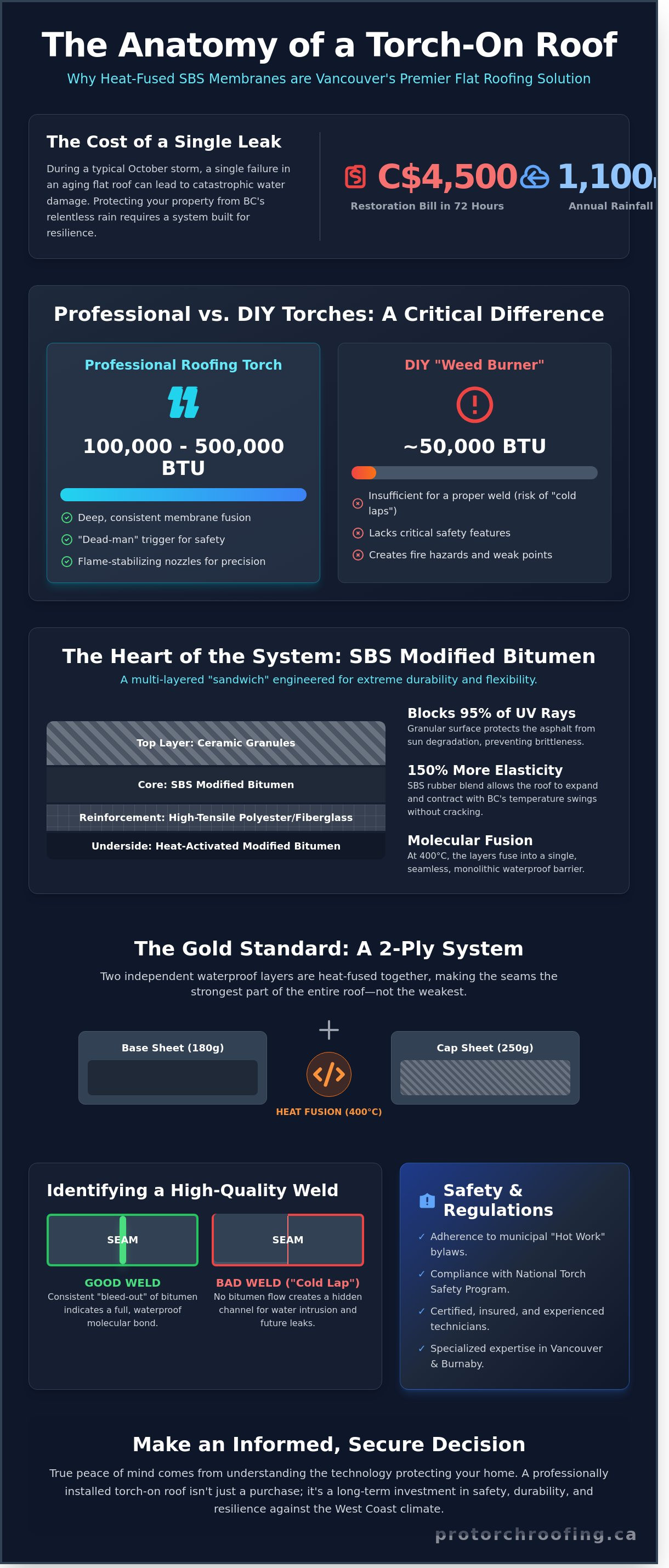
Homeowners often mistake a standard garden weed burner for a professional roofing torch. A typical weed burner produces roughly 50,000 BTUs, which is insufficient for achieving a consistent, deep melt on heavy SBS membranes. Professional-grade kits from manufacturers like Sievert or Magnum deliver between 100,000 and 500,000 BTUs. These professional tools feature "dead-man" triggers and flame-stabilizing nozzles. These safety features ensure the flame extinguishes instantly if the operator loses their grip, providing essential protection for your property during the installation process.
Why Vancouver’s Climate Demands Torch-Applied Systems
The Lower Mainland receives over 1,100 mm of annual rainfall, making water management the top priority for any building. Adhesives used in cold-process roofing can eventually degrade or peel when subjected to the constant hydrostatic pressure of standing water. Heat-fused seams are different. They create a permanent weld that resists pooling water far better than chemical glues. Additionally, British Columbia experiences frequent temperature swings that cause building materials to expand and contract. Because torch-on systems are highly elastic, they maintain their seal throughout these thermal cycles without cracking or becoming brittle.
SBS Membranes: The Material Behind the Flame
High performance flat roofing relies on the durability of SBS modified bitumen. Unlike standard asphalt, SBS incorporates a synthetic rubber called styrene-butadiene-styrene. This specific polymer gives the material 150% more elasticity than traditional tar and gravel systems. The membrane is engineered as a multi-layered sandwich. It features a top layer of ceramic granules, a core of modified bitumen, and a reinforcement layer made of high-tensile polyester or fiberglass. When a professional uses a roofing torch, the heat melts the bitumen on the underside of the roll. This allows it to bond permanently to the substrate. We always install a 2-ply system. This consists of a 180-gram base sheet followed by a 250-gram cap sheet. This double layer provides two independent waterproof barriers for your home.
The Science of Molecular Fusion
At temperatures reaching 400°C, the bitumen transitions from a solid to a viscous liquid. The precise application of the roofing torch ensures the bitumen flows into every micro-fissure of the base sheet. This heat welding process creates a monolithic barrier. The two sheets of membrane fuse at the molecular level. This makes the seams the strongest part of the roof rather than a point of failure. Because this process requires technical precision, our technicians follow the National Torch Safety Program standards to ensure every weld is both watertight and fire-safe. This level of discipline is why we recommend a professional assessment before starting any major project.
Granular vs. Smooth Cap Sheets
Choosing the right finish depends on your specific needs in the Lower Mainland. Granular cap sheets use ceramic-coated stones to shield the bitumen from 95% of harmful UV rays. This is essential for homes in Burnaby where high summer exposure can degrade unprotected asphalt. For visible flat roofs in West Vancouver, these granules offer a clean, uniform look that complements modern architecture. Smooth cap sheets are often used for lower-slope applications or under rooftop decks. While smooth surfaces are easier to clean, they require a protective coating to prevent premature aging. Granular surfaces generally last 20 to 25 years with minimal maintenance intervention.
Fire Safety and Regulations in Burnaby & Vancouver
Fire safety isn't just a recommendation; it's the foundation of every project involving a roofing torch. In British Columbia, the application of heat to a roof structure falls under the classification of "Hot Work." This designation requires specialized insurance policies that go far beyond standard general liability. ProTorch Roofing maintains comprehensive coverage specifically for these high-heat applications, protecting your property from the unique risks associated with open flames. Local municipal bylaws in both Burnaby and Vancouver are strict about how these systems are installed to prevent structural fires in dense urban environments.
The most critical phase of the installation happens after the flame is turned off. Our safety protocol includes a mandatory 120-minute fire watch. A technician stays on the roof for two full hours after the final roofing torch is extinguished to monitor for smoldering embers. We use infrared thermal imaging cameras to scan SBS membranes and perimeter flashing for heat signatures that the naked eye cannot see. This disciplined approach ensures that your building is 100% secure before our crew leaves the site.
Vancouver Building Bylaw Requirements
The Vancouver Building Bylaw mandates specific safety equipment for all flat roof assemblies. Every roofing crew must have at least one 20lb ABC dry chemical fire extinguisher within 3 metres of the torch operator at all times. For commercial projects in high-density areas, the city requires a specific Hot Work permit issued by the Vancouver Fire Rescue Services. These regulations ensure that the structural integrity of neighboring buildings isn't compromised during the installation of high-performance bitumen systems.
The Dangers of Uncertified Torch Work
Hiring an uncertified contractor or attempting a DIY installation is a massive financial and physical risk. Hidden fires often start when heat transfers through metal flashing into wood-frame soffits or old cellulose insulation. These fires can smolder for hours before erupting into a full blaze. If a fire occurs and the installer isn't a Red Seal certified roofer, your BC home insurance provider will likely void your policy. We prioritize hiring Red Seal professionals who understand the technical nuances of heat application, ensuring your project meets all provincial safety standards and protects your long-term investment.
Professional Application vs. DIY: Why Technique Matters
A 2-ply SBS system provides exceptional protection for local properties, but its performance depends entirely on the installer's skill with a roofing torch. It is not just about applying heat. It is about managing thermal energy to create a monolithic seal. Professionals follow the "bleed-out" rule, which requires a consistent 6mm to 12mm bead of melted bitumen to flow from the seam. If this bead is missing, you have a "cold lap." Cold laps are the primary cause of flat roof leaks in British Columbia, as they allow moisture to migrate under the membrane during heavy Burnaby rainstorms.
Maintaining a steady propane pressure between 20 and 30 PSI ensures the flame remains consistent. Fluctuations in heat lead to weak spots. Handling a roofing torch around complex drains and HVAC curbs requires years of experience to avoid damaging the substrate. Precision is the only way to ensure the safety and long-term health of the building.
Common Errors in Amateur Torching
Under-heating is a frequent mistake that leads to delamination, where layers peel apart after just one or two seasons. Conversely, over-heating is equally dangerous. It chars the internal reinforcement of the SBS membrane, making it brittle and prone to premature cracking. Poor corner detailing remains the most frequent failure point in local installations, accounting for nearly 80% of early system failures. Professionals use specific folding and welding techniques at these junctions to ensure they remain watertight under hydrostatic pressure.
The Value of Custom Sheet Metal Integration
A roof is only as strong as its weakest penetration. Professional torching must integrate seamlessly with custom perimeter flashing to prevent wind uplift. We ensure a waterproof seal at every scupper and drain point by custom-fitting metal components before the final membrane application. You can learn about our custom sheet metal work to see how we protect these vulnerable areas. This integration ensures your drainage system works with your membrane to provide total structural integrity.
Specialized Torch-On Roofing Services in the Lower Mainland
Pro Torch Roofing brings over 25 years of specialized experience to every project across Vancouver and Burnaby. Our family-owned business understands that a flat roof isn't just a surface; it's a vital shield against the Pacific Northwest's unpredictable elements. We manage both residential and commercial properties with a disciplined focus on structural integrity and transparent communication. Our team doesn't rely on high-pressure sales. Instead, we provide a methodical process that starts with a meticulous site inspection to identify underlying deck issues or moisture traps.
The application of the roofing torch requires a high level of technical skill to ensure the SBS membranes fuse perfectly. Our technicians follow a strict safety and quality protocol:
Thorough Surface Preparation
We clear all debris and inspect the substrate for rot.
Precision Priming
We apply high-grade primers to ensure maximum membrane adhesion.
Heat-Welded Fusion
We use a professional roofing torch to create a seamless, waterproof bond between plies.
Detail Work
We focus on perimeter flashing and drainage points where 90% of leaks typically occur.
Protecting Your Investment in 2026
A professionally installed 2-ply SBS system offers a lifespan that often exceeds 30 years when maintained correctly. As we head toward 2026, property owners need solutions that can withstand North Vancouver’s intense weather, which sees an average annual rainfall of over 2,500mm. We provide comprehensive warranty options that cover both materials and labour, ensuring you aren't left with unexpected costs. This long-term approach protects your building's value and prevents the structural degradation caused by slow, hidden leaks.
Get a Professional Assessment Today
Attempting a DIY patch with sealant from a hardware store often hides deeper rot without fixing the source of the leak. A professional assessment is the only way to determine if your flat roof needs a targeted repair or a full replacement. We provide clear, honest feedback based on the current state of your membrane and insulation. Don't wait for a ceiling stain to appear before taking action. Contact Pro Torch Roofing for a professional flat roof quote to secure your property and gain the peace of mind that comes with expert craftsmanship.
Protect Your Investment with Specialized Torch-On Expertise
Investing in a high-quality SBS membrane system is the most effective way to safeguard your flat roof against the heavy rainfall typical of the Lower Mainland. Using a roofing torch requires precise technique and strict adherence to local fire safety regulations in Vancouver and Burnaby to ensure your property remains secure. Our family-owned and operated team in Burnaby brings over 25 years of local experience to every project we undertake. We focus on technical precision and long-term structural integrity so you don't have to worry about leaks or premature wear. Choosing a professional application over DIY methods guarantees that your perimeter flashing and membrane seams meet the highest British Columbia industry standards. We've spent more than two decades perfecting these systems to provide property owners with dependable protection. Trusting a local specialist with your installation ensures your home or business is protected against the elements for decades to come. It's about more than just a roof; it's about the safety of your investment.
Secure Your Flat Roof with Vancouver's Torch-On Experts
We look forward to helping you achieve lasting peace of mind for your property.
Frequently Asked Questions
Is torch-on roofing better than EPDM or TPO for Vancouver?
Torch-on roofing is often superior for Vancouver because its multi-layer SBS membrane provides better redundancy against the 1,100mm of annual rainfall we receive. While EPDM is a single-ply 1.5mm rubber sheet, a 2-ply torch-on system creates a 6mm thick waterproof barrier. This thickness handles the freeze-thaw cycles of the Lower Mainland more effectively, ensuring your home's structural integrity remains intact for decades.
Can I use a roofing torch on a rainy day in Burnaby?
No, you cannot safely or effectively use a roofing torch on a rainy day in Burnaby. Trapped moisture under the membrane causes steam pockets that lead to blistering, which can reduce the roof's lifespan by 40%. For a secure bond, the plywood substrate must be 100% dry. We monitor local weather stations and only schedule installations when humidity levels are below 80% and no precipitation is forecasted for 24 hours.
How long does a torch-on roof typically last in British Columbia?
A professionally installed 2-ply torch-on system typically lasts between 20 and 25 years in the British Columbia climate. Regular maintenance every 4 years can extend this lifespan, while neglected roofs might fail after just 12 years. Our SBS membranes are engineered to withstand the 160 days of rain Vancouver sees annually, maintaining their flexibility even during the coldest winter months.
What is the difference between a roofing torch and a weed burner?
A roofing torch is a specialized tool that produces up to 500,000 BTUs and features a regulated valve for consistent heat distribution. Weed burners lack the precision and safety triggers required for construction work. Using a weed burner for roofing increases fire risk by 70% because it doesn't provide the controlled melt needed for a proper SBS bond. Professional torches ensure the membrane reaches exactly 175°C for optimal adhesion.
Does insurance cover fire damage if I use a roofing torch myself?
Most standard BC residential insurance policies exclude coverage for fire damage caused by hot-work performed by an unlicensed individual. Professional contractors carry C$5 million in specialized "Hot Work" liability insurance to protect your property during the project. If a DIY attempt results in a fire, the homeowner is often 100% liable for all repair costs. It's vital to verify that your roofer has valid WorkSafeBC coverage before any work begins.
What is 'bleed-out' in torch-on roofing and why is it important?
Bleed-out is the 12mm bead of melted bitumen that seeps out from the seams during the heating process. This visible flow confirms a watertight seal has been formed between the two layers of the SBS system. If there's no bleed-out, the seam is considered "cold" and is 80% more likely to leak within the first 24 months. Our technicians ensure a consistent bleed-out along every perimeter flashing to guarantee long-term protection.
How much propane is needed for a standard residential flat roof?
A standard 1,500 square foot residential flat roof in Vancouver typically requires 2 to 3 full 20lb propane tanks. Consumption rates increase by 15% during a 5°C Burnaby winter because more heat is required to reach the bitumen's melt point. This fuel powers the roofing torch to fuse the base and cap sheets together, creating a seamless waterproof barrier across the entire roof surface.
Are there flameless alternatives to torch-on roofing?
Yes, self-adhered SBS membranes and cold-applied adhesives are effective flameless alternatives for high-risk areas. These systems are ideal for wooden parapets or near HVAC intakes where using an open flame is dangerous. While these materials can cost 20% more than standard rolls, we often use a "hybrid" approach. This combines flameless technology in sensitive spots with a roofing torch on the main field to balance safety and cost-effectiveness.
