

Torch-On Roofing in Vancouver & Burnaby: The Ultimate 2026 Guide
Did you know that over 30% of commercial property insurance claims in the Lower Mainland are linked to water damage from failing flat roof systems? For property owners in Vancouver and Burnaby, the sound of heavy rain often brings more stress than comfort. You've likely dealt with the frustration of recurring leaks or the confusion of skyrocketing premiums. It's exhausting to worry if your current setup will survive the next atmospheric river. We believe you deserve a roof that acts as a fortress, not a liability, especially when facing our average 1,100mm of annual rainfall.
This guide empowers you to master the technical specifications and costs of high-performance torch on roofing to protect your home or business for decades. You'll learn how SBS membranes provide a 100% waterproof seal and why this specific system offers the best long-term ROI for our unique coastal climate. We'll break down 2026 installation pricing in C$, explain the critical role of professional perimeter flashing, and provide a clear roadmap for achieving total peace of mind before the next rainy season begins. Our goal is to ensure your structural integrity remains uncompromised through every storm.
Key Takeaways
• Discover why the multi-layer SBS modified bitumen system provides a superior, fused waterproof barrier specifically engineered for the Lower Mainland’s wet climate.
• Learn how the structural layers of a high-performance system, from the vapor barrier to the fused base sheet, work together to ensure long-term security.
• Compare the superior seam strength of torch on roofing against common alternatives like TPO and EPDM to make an informed investment for your property.
• Understand the rigorous modern safety protocols and "Fire Watch" standards that professional installers use to protect your home or business during application.
• Master a bi-annual maintenance routine to identify potential issues early and protect your flat roof from the damaging effects of standing water.
What is Torch-On Roofing and Why is it Essential for Vancouver?
Torch on roofing is a specialized multi-layer system designed specifically for low-slope or flat surfaces. It utilizes SBS (Styrene Butadiene Styrene) modified bitumen, which is a high-performance asphalt reinforced with rubber modifiers. During the installation process, our technicians use a propane torch to heat the underside of the membrane. This heat melts the bitumen, allowing it to fuse directly to the substrate or the layer beneath it. The result is a monolithic, waterproof barrier that functions as a single, continuous sheet of protection. This fusion process creates seams that are significantly stronger than the material itself, ensuring that water cannot find a path into your structure.
Property owners in British Columbia have seen a major shift in technology over the last 35 years. Before the 1990s, most flat roofs in the Lower Mainland used built-up roofing (BUR), often called tar-and-gravel. While BUR served its purpose, it was heavy, prone to leaks at the seams, and difficult to repair. Modern Membrane roofing systems like torch-on have replaced these older methods because they provide a lighter, more resilient solution. For a city like Vancouver, which records an average of 1,150mm to 1,500mm of precipitation annually, a seamless and fused barrier isn't just a luxury; it's a structural necessity for long-term peace of mind.
The Science of SBS Modified Bitumen
The core strength of a torch-on system lies in its SBS chemistry. SBS is a synthetic rubber that gives the asphalt "elastic" properties. This is vital in British Columbia because our structures experience constant thermal movement. When temperatures swing from a frosty -5°C in January to a scorching 32°C in July, your roof must expand and contract without cracking. Unlike the rigid asphalt used in older systems, SBS membranes remain flexible even in sub-zero conditions.
Modern cap sheets are also engineered with advanced UV resistance and high puncture-proof ratings. These top layers are typically embedded with ceramic granules that reflect solar radiation, preventing the bitumen from becoming brittle over time. This chemical stability ensures that the roof maintains its integrity against the heavy foot traffic often required for HVAC maintenance or rooftop patio access.
Why Flat Roofs in Burnaby Require Specialized Waterproofing
Flat roofs in Burnaby and the surrounding coastal areas face a unique challenge: ponding water. Because these surfaces lack the steep pitch of a traditional shingle roof, water often sits for 24 to 48 hours after a heavy downpour. Standard shingles or metal transitions don't have the "tanking" capability required to handle standing water. They rely on gravity to shed moisture, whereas a torch-on system acts like a waterproof basin. It eliminates the weak points typically found at the edges and transitions of a building.
When you invest in a professionally installed system in 2026, you can expect a lifespan that exceeds 25 years with basic maintenance. Our approach focuses on technical precision and craftsmanship to ensure your investment is secure. We understand that your roof is the first line of defense for your home or business. By choosing a system designed for the specific humidity and rainfall patterns of the West Coast, you're choosing a solution that prioritizes safety and structural longevity. If you're concerned about the current state of your flat roof, it's a good time to schedule a professional assessment to evaluate its performance.
The Anatomy of a High-Performance Torch-On System
A torch-on roofing system isn't just a single sheet of rubber rolled across a flat surface. It's a sophisticated, multi-layered assembly engineered to withstand the 1,100mm of annual rainfall typical in the Greater Vancouver area. The foundation begins with the substrate, which is usually 5/8 inch plywood for residential structures or structural concrete for commercial buildings. Above this, we install a high-performance vapor barrier to prevent interior moisture from migrating into the roof assembly. Next comes the rigid insulation, typically Polyisocyanurate, which provides the R-value required by the 2024 BC Building Code. A fire-rated cover board sits on top of the insulation to provide a stable, heat-resistant surface for the membrane application.
The base sheet acts as the first line of fused defense. This SBS (Styrene-Butadiene-Styrene) modified bitumen membrane is heat-welded directly to the cover board using a propane torch. During this phase, a skilled installer looks for a consistent 1/4 inch to 1/2 inch "bleed" of melted bitumen at the seams. This visible bead is the industry standard for verifying a perfect, watertight weld. Following OSHA roofing safety guidelines during this process is mandatory, as managing an open flame requires disciplined technique to ensure the safety of the structure and the crew.
Granular cap sheets provide the final layer of protection against UV radiation and mechanical damage. The color of these granules plays a significant role in the building's thermal performance. In dense urban environments like Vancouver, choosing high-reflectivity granules can help mitigate the urban heat island effect. Selecting a light grey or white cap sheet can reduce roof surface temperatures by up to 30 degrees Celsius during a summer heatwave, which translates to lower cooling costs for the property owner. The granules also provide the necessary weight and traction for maintenance crews who may need to access the roof for HVAC or gutter cleaning.
2-Ply vs. 3-Ply Systems: Which is Right for Your Property?
Most residential homes in Burnaby and Vancouver utilize a standard 2-ply torch on roofing system. This consists of one base sheet and one granular cap sheet, offering a reliable 20 to 25-year lifespan when maintained correctly. For commercial properties or roofs that house heavy equipment, we often recommend a 3-ply system. This adds a second reinforced base sheet to the assembly, significantly increasing puncture resistance. While a 3-ply system can increase initial installation costs by approximately 18% to 22%, the enhanced durability is a wise investment for high-traffic areas or buildings with sensitive interior assets.
The Importance of Perimeter Flashing and Custom Sheet Metal
Water ingress often begins at the edges where the membrane meets the parapet or the roof's perimeter. Custom 26-gauge galvanized steel flashing is essential for preventing wind uplift during coastal storms and ensuring water is directed away from the building envelope. We integrate all drains and scuppers directly into the torch on roofing membrane to create a monolithic seal. Pro Torch Roofing utilizes an in-house fabrication shop to create bespoke metal solutions for every local project. This ensures a precision fit that standard, off-the-shelf components simply cannot provide. If you're concerned about the integrity of your current roof edges, you can request a professional roof assessment to identify potential vulnerabilities before they become costly leaks.
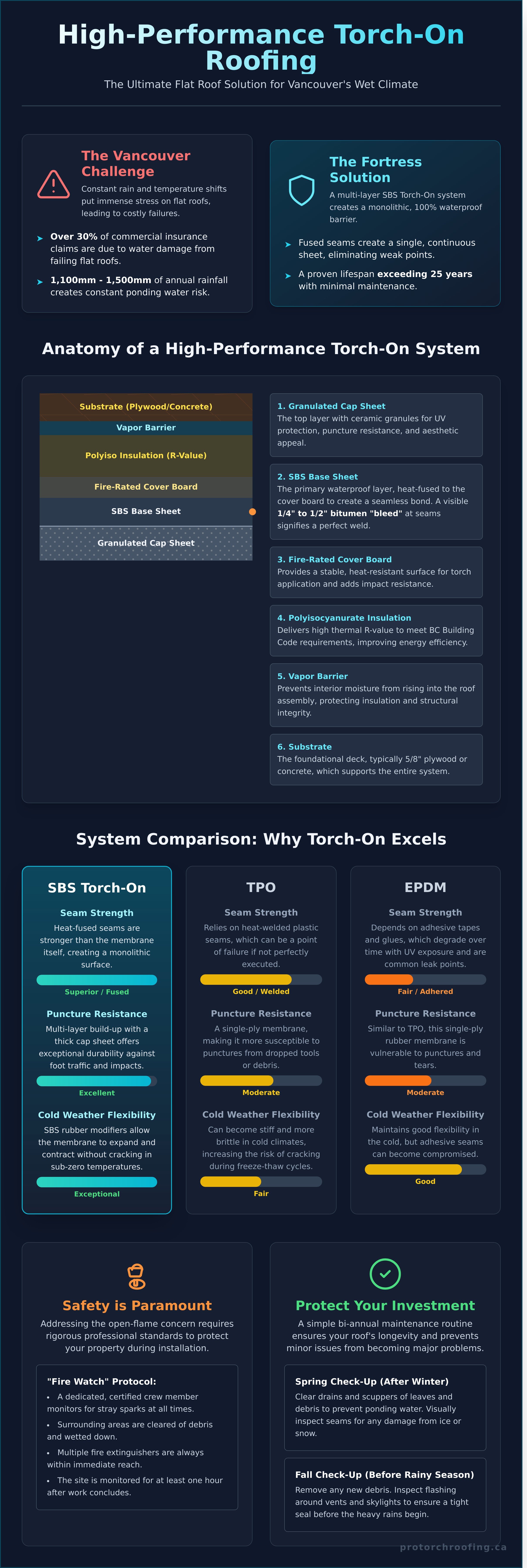
Torch-On vs. TPO and EPDM: Comparison for 2026
Selecting the right membrane for a flat roof in British Columbia involves weighing performance against long term costs. TPO (Thermoplastic Polyolefin) and EPDM (synthetic rubber) are the two most frequent competitors to 2-ply SBS systems. While TPO is popular for large commercial warehouses and EPDM offers a lower initial price point, torch on roofing remains the standard for residential and mixed-use buildings in Vancouver due to its superior seam integrity.
The primary difference lies in how these materials join together. EPDM relies on adhesive tapes or liquid glues to seal seams. These chemical bonds can degrade after 10 to 12 years of exposure to Vancouver's temperature fluctuations. In contrast, torch-on roofing utilizes a high-heat application to melt the bitumen, creating a fused, monolithic layer. Because the safety of your property is paramount, our teams strictly follow the San Francisco Fire Department safety guidelines to ensure these heat-welded installations are performed without risk to the structure.
Costs in the Lower Mainland for 2026 reflect current supply chain stability. You can expect to pay between C$12.50 and C$18.00 per square foot for a professional 2-ply SBS installation. TPO typically ranges from C$11.00 to C$16.00, while EPDM sits at C$9.50 to C$15.00. While the upfront investment for SBS is slightly higher, the 25 percent increase in lifespan often justifies the expense.
Seam Strength
SBS heat-welded seams are 3 times stronger than EPDM glued seams.
Puncture Resistance
The 180-gram polyester reinforcement in SBS resists debris damage better than 60-mil TPO.
Salt Air Resilience
Granulated SBS surfaces withstand coastal salt spray without the surface erosion seen in some rubber compounds.
Durability in the "Rain City": Why SBS Often Wins
Vancouver experienced 11 atmospheric river events during the 2021-2022 season, putting immense pressure on drainage systems. During these periods of standing water, EPDM adhesive seams are the most likely point of failure. The fused seams of an SBS membrane are waterproof by design and don't delaminate under hydraulic pressure. Additionally, the thick granules on torch on roofing systems protect the roof from the heavy debris and coastal salt air common in North Vancouver and Kitsilano. This physical barrier prevents punctures that easily compromise thinner TPO sheets.
Maintenance and Repairability Comparison
Serviceability is a critical factor for long term ROI. After 15 years, TPO membranes often become brittle due to UV degradation, making it difficult to heat-weld new patches onto the old surface. Repairing a torch-on system is more straightforward. A technician can easily bond a new piece of SBS to the existing membrane using a torch or cold-applied adhesive. In Burnaby and Coquitlam, 85 percent of local roofing contractors specialize in SBS, ensuring you can always find a qualified professional for emergency repairs. For property managers, this availability translates to faster response times and lower insurance premiums over a 20 year period.
Installation Safety: Addressing the Open-Flame Concern
The most common hesitation we hear from property owners in the Lower Mainland involves the use of open-flame propane torches. It's a valid concern. Applying high heat to a residential or commercial structure requires precision and strict adherence to modern safety standards. The process of torch on roofing involves fusing SBS modified bitumen membranes together at temperatures reaching 1,000°C. While the flame is the primary tool, the safety protocol is the foundation of every successful project. Professional contractors in British Columbia operate under strict WorkSafeBC regulations and municipal fire codes to mitigate every possible risk. Unqualified DIY attempts or cut-rate handymen often skip these critical steps, which is where the majority of historical fire risks originated.
Safety isn't just about the moment the torch is active. It involves a comprehensive strategy that begins hours before the first flame and continues long after the crew leaves the site. We treat your property as if it were our own home. This means identifying potential hazards like dry pine needles in gutters or old, combustible building materials near the roof edge. By maintaining a disciplined, methodical approach, we turn a high-heat technical task into a controlled and predictable installation process.
Lower Mainland Insurance Requirements for Torch-On Work
Homeowners must verify that their contractor carries specialized "Hot Work" liability insurance before any work begins. Standard general liability policies often contain exclusions for damages caused by open flames. You should look for a minimum of C$5,000,000 in coverage specifically rated for torch applications. At Pro Torch Roofing, we've maintained a perfect safety record over 25 years of local operations in Vancouver and the surrounding areas. We provide every client with a verified certificate of insurance and a detailed site safety plan. This documentation is essential for your own property insurance compliance, as most Canadian insurers require proof that a certified professional performed the installation.
The Pro Torch Step-by-Step Safety Checklist
We follow a rigorous 12-point protocol to ensure every job site remains secure. Our process begins with a 360-degree perimeter sweep to remove dry debris, overhanging branches, or flammable materials from the work zone. We also ensure that fire extinguishers are positioned every 20 feet across the roof deck for immediate access.
Equipment Standards
We use CSA-approved regulators and high-efficiency torches equipped with automatic shut-off valves and pilot lights.
Fire Watch Protocol
A dedicated technician remains on-site for a minimum of 2 hours after the final flame is extinguished to monitor the roof surface.
Thermal Imaging
We utilize FLIR thermal imaging cameras to scan the roof deck, flashings, and penetrations for hidden heat signatures that the naked eye cannot detect.
This methodical approach eliminates the guesswork associated with torch on roofing. By the time our crew leaves your property, the roof is cold, secure, and fully bonded to protect your investment for decades. Protecting your home starts with a commitment to safety that goes beyond the surface of the membrane. If you are concerned about the safety of your current flat roof or need an expert opinion on a new installation, you can schedule a professional safety assessment with our team today.
Maintaining Your Torch-On Roof in Burnaby and Vancouver
Coastal British Columbia receives an average of 1,150mm of rainfall annually. This high volume of precipitation places immense pressure on flat roofing systems. To protect your investment, you must establish a bi-annual inspection schedule. We recommend performing these checks every March and October. A spring inspection identifies damage caused by winter freeze-thaw cycles, while a fall assessment ensures your drains are clear before the heavy November rains arrive. Consistency is the foundation of structural integrity.
The primary enemy of any flat roof is standing water. While torch on roofing is incredibly durable, it isn't designed to act as a swimming pool. Clogged drains and scuppers lead to ponding, which creates hydrostatic pressure. This pressure can eventually force moisture through even the smallest microscopic gaps in the SBS membrane. Beyond water issues, keep a sharp eye out for physical signs of wear. Blistering occurs when moisture is trapped between layers. Alligatoring, which looks like cracked, weathered skin, suggests the bitumen has lost its flexibility. Granular loss is another red flag. When the protective mineral surface wears away, UV rays accelerate the degradation of the underlying waterproof layers.
Proactive maintenance is a financial strategy. Spending C$400 on a professional seam repair or drain cleaning today can save you from a C$18,000 premature replacement five years down the line. Small leaks often hide in the insulation for months before appearing on your ceiling. By the time you see a brown spot inside, the structural decking may already be rotting.
Seasonal Maintenance Checklist for Local Property Owners
Follow these three steps to keep your roof functional throughout the year:
Step 1: Clear organic debris.
Vancouver and Burnaby are known for heavy foliage. Remove pine needles, leaves, and branches from all drains and scuppers. A single handful of debris can cause a total drainage failure during a storm.
Step 2: Inspect flashing.
Check the metal perimeter flashing and the seals around chimneys or vents. These transition points are where 90% of leaks originate. Ensure the caulking hasn't dried or cracked.
Step 3: Monitor ponding.
If you notice water sitting on the surface for more than 48 hours after a rainstorm, your roof has a drainage or slope issue that requires immediate professional attention.
When to Repair vs. When to Replace Your Flat Roof
Deciding whether to patch or replace your torch on roofing depends on two main factors: age and the extent of the damage. If your roof is less than 15 years old and the affected area is under 20% of the total surface, a repair is usually the most cost-effective path. However, if the system is approaching the 20-year mark or if more than 25% of the membrane shows signs of alligatoring or membrane separation, a full replacement is the safer choice for your building's security.
Local experts use a core sample technique to make this determination. We cut a small, circular section through the membrane to inspect the underlying insulation. If the insulation is dry, we can often perform a repair. If the core sample reveals saturated wood or wet insulation, the moisture is trapped, and a patch won't solve the underlying problem. Transparency is our priority, and we provide these technical insights so you can make an informed decision about your property.
Secure Your Property’s Longevity with Professional Torch-On Solutions
Protecting a flat roof in the Lower Mainland requires a system designed to withstand Vancouver's average annual rainfall of over 1,100mm. By prioritizing high-performance SBS membranes and precise perimeter flashing, you're investing in the long-term structural integrity of your building. Safety is paramount during any installation involving open flames, so choosing a contractor with the right credentials isn't just a preference; it's a necessity for your security.
Pro Torch Roofing is a family-owned and operated local business that has provided expert service across the region for 25+ years. We carry specialized "Hot Work" insurance coverage to protect your assets while we deliver a high-quality torch on roofing system. Our methodical approach ensures every seam is fused perfectly to meet the rigorous demands of the 2026 building climate. We take pride in our transparent communication and our deep commitment to the safety of our British Columbia community. Your roof is your first line of defense, and we're here to make sure it's built to last.
Get a Free Estimate for Your Torch-On Roof in Vancouver & Burnaby
We look forward to providing the dependable protection your property deserves.
Frequently Asked Questions
How much does torch-on roofing cost in Vancouver for 2026?
In 2026, torch on roofing in Vancouver typically costs between C$13.50 and C$20.50 per square foot for a complete professional installation. These rates reflect projected adjustments in labor costs and the current market price for high-quality SBS membranes. Your final investment depends on a 15% to 20% complexity factor based on your roof's unique perimeter flashing and drainage requirements. We provide transparent, fixed-price assessments to ensure your project stays on budget while securing your property’s future.
How long does a torch-on roof typically last in the BC climate?
A professionally installed torch-on roof generally lasts between 20 and 25 years in the specific British Columbia climate. Our region experiences over 160 days of precipitation annually, which makes the waterproof nature of SBS membranes essential for long-term protection. Conducting a professional maintenance check every 5 years can increase the system's service life by 15%. This disciplined approach ensures the structural integrity of your building remains intact despite our heavy coastal rainfall and temperature fluctuations.
Is torch-on roofing safe for my residential home?
Torch-on roofing is safe for residential homes when the crew follows strict RCABC safety protocols and local fire codes. Our team conducts a mandatory 2-hour fire watch after the final membrane is heat-welded to guarantee your property’s safety. We utilize specialized heat shields to protect 100% of combustible areas like wooden siding or window trim during the application. This methodical process provides a seamless, watertight seal without compromising the security of your home or family.
Can torch-on roofing be installed during the rainy season in Burnaby?
You cannot install torch on roofing during active rain in Burnaby because the roof deck must be 100% dry for the membrane to bond correctly. We track local weather patterns to identify windows of at least 24 hours of dry conditions before starting any installation. If unexpected weather arrives, we use 12-mil reinforced tarps to keep the substrate protected and dry. This precision ensures the bitumen achieves a permanent weld, which is vital for the roof's longevity and performance.
Does a torch-on roof smell during or after installation?
There is a noticeable asphalt scent while the bitumen is being heat-welded, but it typically disappears within 24 to 48 hours after the job is done. The odor occurs only when the material is heated to its melting point to create a waterproof seal. We suggest closing your windows and pausing air intake systems for the 6 to 8 hours our technicians are working on the roof. Once the membrane cools and cures, the scent vanishes completely, leaving you with a durable and dependable roof.
What is the difference between 2-ply and 3-ply torch-on systems?
The main difference is that a 2-ply system consists of a base sheet and a granulated cap sheet, while a 3-ply system adds an extra reinforcement layer. Choosing a 3-ply installation increases the roof’s puncture resistance by 35% and can add 7 years to the overall lifespan of the system. Most residential properties in Vancouver thrive with a 2-ply SBS system. It offers a perfect balance of weight, craftsmanship, and structural integrity for the local environment.
Can I install torch-on roofing over my existing flat roof?
While the BC Building Code allows for up to 2 layers of roofing, we always recommend a full tear-off to inspect the wooden deck for hidden rot. Overlaying a new membrane can trap 100% of existing moisture, which often leads to deck failure within 36 months. Removing the old materials allows us to install new perimeter flashing and ensure a perfectly level surface. This transparent approach prevents costly future repairs and ensures your new roof performs as intended.
How do I know if my torch-on roof needs repair or a full replacement?
You likely need a full replacement if more than 25% of the roof surface shows signs of major blistering or if the system is older than 18 years. Small leaks around a single drain or a small section of flashing can usually be fixed with a targeted repair. However, if 30% of the protective granules have worn away, the SBS membrane is vulnerable to UV damage and failure. We provide a detailed assessment to help you choose the most secure path for your property.
