

Torch-on Roofing in Vancouver: The Complete 2026 Property Owner’s Guide
In the relentless damp of a Vancouver winter, a flat roof is your property's most vulnerable point of failure. You've probably spent nights worrying about the telltale ceiling stains that signal a failing tar and gravel system or a membrane that wasn't designed for our coastal humidity. It's a stressful cycle of temporary patches and rising maintenance costs that no property owner should have to manage alone.
We believe your roof should provide absolute peace of mind, not a list of structural concerns. This complete 2026 guide explains why torch on roofing is the definitive solution for achieving a 100% waterproof seal in British Columbia. By utilizing high-performance SBS membranes and precision installation techniques, you can secure a roof that lasts 25 years or more while significantly increasing your property's value and structural protection.
We will walk you through the essential 2026 BC Building Code updates, the importance of R-40 insulation standards, and how our specialized focus on custom sheet metal fabrication creates the perfect perimeter defense. You'll gain the technical knowledge needed to navigate local regulations and select a system that provides permanent, dependable protection for your home or business.
Key Takeaways
• Understand why rubber-based SBS membranes are the superior choice for Vancouver’s damp climate compared to rigid plastic alternatives.
• Learn how a professionally installed torch on roofing system creates a seamless, heat-welded barrier that provides up to 30 years of waterproof protection.
• Discover the critical role of vapour barriers and custom sheet metal flashing in preventing internal condensation and protecting your property’s structural integrity.
• Identify the simple biannual maintenance steps that prevent moss buildup and ensure your flat roof drainage remains clear throughout the rainy season.
• See how upgrading to a modern multi-ply system meets the 2026 BC Building Code standards while increasing your property’s long-term resale value.
Torch-on Roofing: Why it's the Standard for Vancouver
Torch-on roofing is a specialized multi-layer membrane system designed specifically for flat and low-slope structures. While standard asphalt roll roofing provides a basic barrier, torch-on uses bitumen modified with high-grade polymers to create a flexible, rubberized shield. The name itself describes the application; professionals use a propane torch to melt the seams together. This process creates a singular, waterproof surface that doesn't rely on mechanical fasteners or adhesives that can fail over time. It is the gold standard for structural protection in the Pacific Northwest.
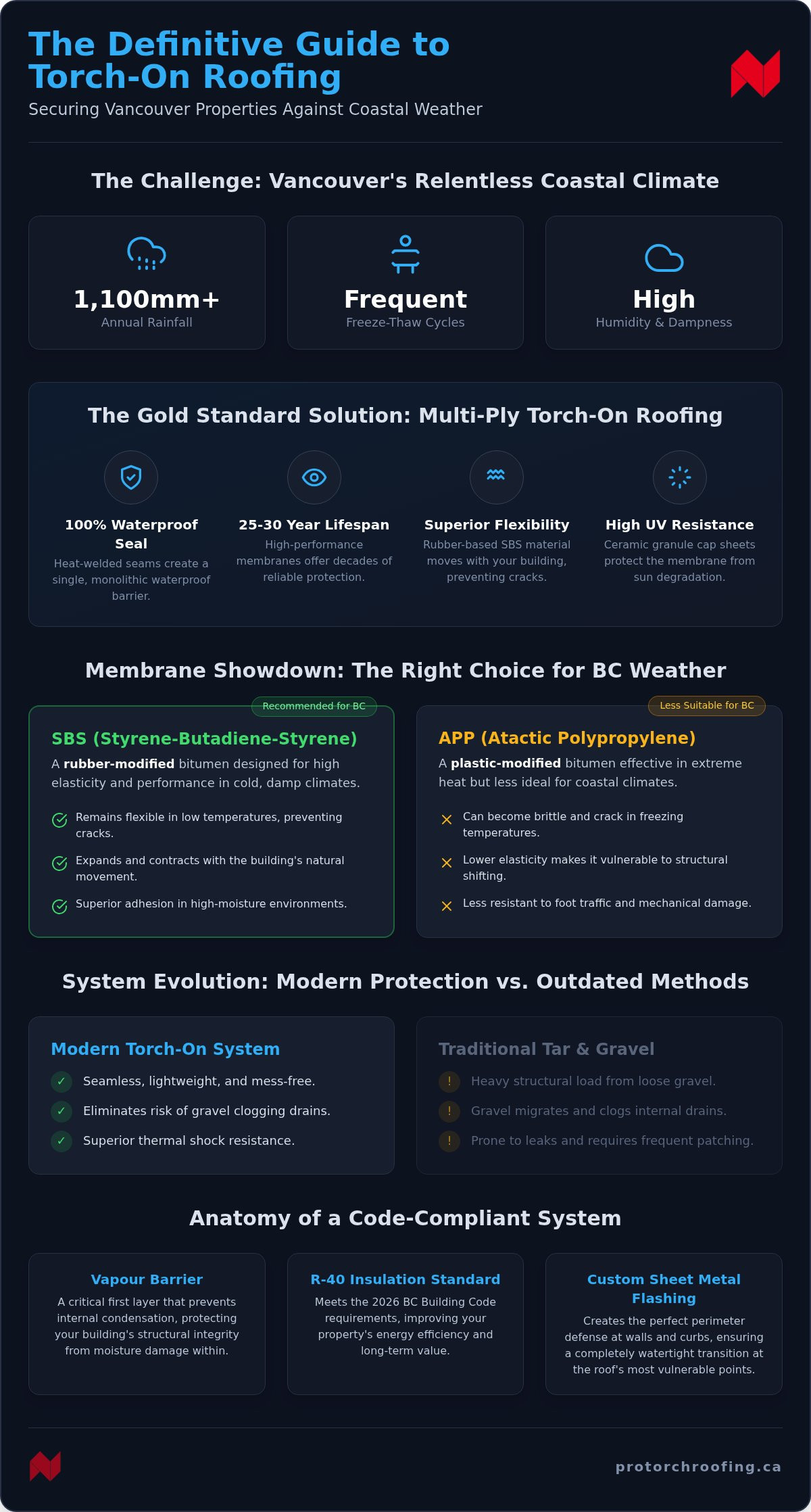
The core of this system is the bitumen, which is modified with Styrene-Butadiene-Styrene (SBS). This addition of rubber-like polymers ensures the roof remains pliable even when the temperature drops. Instead of becoming brittle like traditional asphalt, torch on roofing maintains its integrity, allowing it to move with your building. This flexibility is what prevents the cracks and leaks that often plague older flat roof designs. For property owners, this means fewer repairs and a significantly longer service life for the entire structure.
The Evolution of Flat Roofing in British Columbia
Traditional tar and gravel systems served their purpose for decades, but they came with significant headaches for local property owners. In areas like Burnaby, loose gravel often migrated into internal drains, causing blockages and structural water damage during heavy storms. Modern multi-ply systems have solved this. By moving to SBS membranes, we've eliminated the mess and weight of gravel while improving thermal shock resistance. This transition represents a major leap in how we protect local homes and businesses from the elements, ensuring that your roof stays in place and stays dry.
Meeting Vancouver Coastal Climate Challenges
Our local environment is uniquely demanding. With over 1,100mm of annual rainfall in the Lower Mainland, a flat roof must be perfectly watertight. Torch-on systems excel here because their heat-welded seams are physically stronger than the membrane itself. This is vital for North Vancouver properties that face frequent freeze-thaw cycles; the rubberized bitumen expands and contracts without losing its seal. Additionally, modern cap sheets are engineered with ceramic granules for high UV resistance. This protects the membrane from degradation during the intense exposure of our summer months, ensuring the system reaches its full 25 year lifespan.
SBS vs. APP: Choosing the Right Membrane for BC Weather
Choosing the right membrane is the difference between a roof that lasts decades and one that fails after the first major freeze. Two main technologies dominate the market: SBS and APP. While both are used in torch on roofing, their chemical compositions lead to very different performance profiles. SBS (Styrene-Butadiene-Styrene) is a rubber-modified bitumen designed for high elasticity. APP (Atactic Polypropylene) is modified with plastic, making it tougher against extreme heat but more brittle when the temperature drops. According to the Asphalt Roofing Manufacturers Association, these modifications significantly change how the asphalt behaves under structural stress.
In Vancouver, where we face high humidity and frequent temperature swings, the "rubberized" nature of SBS is almost always the superior choice. The cap sheet of an SBS system is finished with a granular top surface. These ceramic granules aren't just for aesthetics; they provide the primary defense against UV radiation and physical wear. If you're unsure which membrane fits your specific building, it's best to consult with a local specialist who understands BC's coastal requirements.
The SBS Advantage: Flexibility and Longevity
The primary benefit of SBS is its ability to move. Buildings in West Vancouver often experience significant expansion and contraction due to moisture levels and shifting soil. Because SBS is rubberized, it stretches and recovers its shape without cracking. It also offers superior adhesion properties in high-moisture environments, which is critical during our rainy season. For those with rooftop decks or areas requiring frequent access, SBS provides better resistance to mechanical damage and foot traffic than its plasticized counterparts.
2-Ply vs. 3-Ply Systems: Which Do You Need?
Most residential applications utilize a 2-ply system, consisting of a base sheet and a granular cap sheet. This creates a redundant, waterproof barrier that's perfectly adequate for standard homes. However, for maximum commercial durability, a 3-ply system is often recommended. This setup typically adds an asphaltic board layer or an extra ply of membrane to provide greater structural rigidity and puncture resistance. While a 3-ply system requires a higher initial investment, the added protection often pays for itself through reduced maintenance and an even longer service life in harsh coastal conditions.
Comparing Torch-on to Other Flat Roofing Systems
When you evaluate options for a flat roof, you'll likely compare torch on roofing against single-ply membranes like TPO or EPDM. While single-ply options are lightweight, they lack the multi-layered redundancy that defines a modified bitumen system. In our coastal climate, where windstorms frequently toss debris onto rooftops, the sheer thickness of a multi-ply system provides a critical buffer against punctures. Choosing the right material requires you to balance upfront costs with the long-term structural health of your building. While EPDM (rubber) is popular in drier regions, it often struggles with seam integrity under the constant hydrostatic pressure of Vancouver's heavy rainfall.
The reliability of these systems depends heavily on the skill of the installers. High-quality results come from teams who have completed industry-standard safety training to ensure every seam is fused perfectly without compromising the building's safety. This level of precision is why torch-on remains the preferred choice for property owners who prioritize longevity and security over the lowest possible bid.
Torch-on vs. TPO: The Durability Debate
Single-ply TPO (Thermoplastic Polyolefin) is often marketed for its reflective properties, but it remains vulnerable to punctures from falling branches or maintenance foot traffic. If a single-ply membrane is breached, water immediately penetrates the insulation and decking. In contrast, torch-on systems offer a dual-layer defense. You have a base sheet and a reinforced cap sheet working in tandem. This built-in redundancy is why we typically see a lifespan of 20 to 25 years for torch-on, compared to the 15 to 20 years often expected from TPO installations in the Lower Mainland.
Why Tar and Gravel is Fading from the Vancouver Market
Older residential structures in Burnaby were frequently built using traditional built-up roofing (BUR), commonly known as tar and gravel. These systems are incredibly heavy, often adding thousands of kilograms of dead weight to a home's frame. As these structures age, that weight becomes a structural liability. Gravel also makes leak detection nearly impossible; a technician must shovel away layers of rock just to find a single hairline crack. Transitioning to a modern torch-on system removes this unnecessary weight, simplifies future inspections, and provides a cleaner profile that's easier to maintain and eventually replace.
The Professional Installation Process: Safety and Precision
A successful installation begins long before the first torch is lit. We start by stripping away all existing materials to inspect the underlying roof deck for rot or structural weaknesses. This stage is vital because even the best torch on roofing membrane cannot compensate for a compromised foundation. Once the deck is secured, we install a high-performance vapour barrier. In our coastal climate, this layer is essential for preventing interior humidity from condensing against the underside of the roof, which protects your insulation and prevents long-term structural decay.
The actual application of the SBS membrane involves a methodical heat-welding technique. By carefully melting the bitumen on the underside of the roll, our team fuses the seams together to create a single, monolithic waterproof sheet. We pay particular attention to the "bleed-out" at the seams, which serves as a visual indicator of a perfect, 100% airtight bond. This precision ensures that water cannot find a path into your building, even during the most severe Pacific storms.
Fire Safety and Professional Standards
Because this process involves open flames, hiring a certified roofing contractor in Burnaby is a matter of safety and legal compliance. We adhere to rigorous safety protocols, including a mandatory two-hour fire watch after the last torch is extinguished. Our crews utilize thermal imaging cameras to scan the roof for any heat signatures that might indicate a hidden hot spot. This disciplined approach is essential for any torch on roofing project, providing you with total security throughout the replacement process.
Custom Sheet Metal and Perimeter Flashing
Vulnerable points like drains, vents, and parapet walls require more than just standard materials. Standard off-the-shelf flashing often fails to provide a perfect seal on unique Vancouver architecture. To solve this, we utilize our in-house custom metal shop to fabricate perimeter flashing and parapet caps specifically for your building's dimensions. This ensures that every transition is airtight and every drain is properly integrated into the membrane. If you want to ensure your property remains protected, you can request a professional assessment of your roof's perimeter health.
Maintaining Your Torch-on Roof: Extending Longevity in the Lower Mainland
A common misconception among property owners is that a torch on roofing system requires zero attention after installation. While it's true that SBS membranes are incredibly resilient, the Pacific Northwest environment is uniquely aggressive. In the Lower Mainland, our heavy tree canopy and high humidity create a perfect breeding ground for moss and organic debris. If left unchecked, this growth can obstruct your drainage systems and lead to standing water. Consistent roof maintenance is the most effective way to ensure your system reaches its full 25 year potential without requiring emergency interventions.
Professional oversight helps you identify minor issues before they become structural liabilities. It's not just about cleaning; it's about verifying the integrity of the heat-welded seams and the condition of the custom metal flashing. Small cracks or clogs are easy to fix during a scheduled visit but can cause thousands of dollars in damage if they lead to an interior leak during a December storm.
Seasonal Care for Vancouver Property Owners
You should schedule inspections twice a year to match our local weather patterns. Fall preparation is critical; you must clear all gutters, scuppers, and internal drains before the heavy November rains arrive. When organic matter builds up, it creates a dam that forces water to sit on the membrane longer than intended. In the spring, we check for any seam separation that might have occurred during winter freeze-thaw cycles. We also examine your attic ventilation. Proper airflow is essential because it prevents heat from becoming trapped under the roof deck, which can "cook" the membrane from the inside out and cause premature failure.
When to Call for Professional Roof Repair
It's important to know the visual cues of a failing system. Look for "alligatoring," which is a pattern of small cracks that look like reptile skin, or significant granular loss on the cap sheet. These are signs that the bitumen is drying out and losing its UV protection. Another red flag is ponding water that remains on the roof for more than 48 hours after a rainstorm. This often indicates a structural sag or a blocked drainage path that requires immediate professional attention. Don't wait for a ceiling stain to take action. Protect your investment with a professional assessment from Pro Torch Roofing.
Secure Your Property with a 25-Year Waterproofing Strategy
Protecting your flat roof in the Lower Mainland requires more than just a standard membrane. It demands a system engineered for our specific coastal challenges. By choosing a high-performance SBS system, you ensure your building remains resilient against heavy rainfall and freeze-thaw cycles. The long-term success of torch on roofing depends on the precision of the heat-welded seams and the quality of the perimeter protection. Custom sheet metal flashing isn't an optional extra; it's the final line of defense for your property's structural integrity.
Pro Torch Roofing brings over 25 years of local experience and specialized expertise to every project. We handle everything from residential replacements to complex commercial systems. Our team utilizes an in-house custom sheet metal shop to create airtight seals for every drain and parapet. You deserve the peace of mind that comes with a roof designed to last for decades. Take the first step toward a secure, maintenance-optimized future for your home or business today.
Get a Professional Torch-on Roofing Estimate Today. Let our team of disciplined experts provide the specialized care your property deserves.
Frequently Asked Questions
How long does a torch-on roof last in Vancouver?
A professionally installed torch-on roof typically lasts between 20 and 30 years in our coastal climate. Its total lifespan depends on regular maintenance and the quality of the initial craftsmanship. Because SBS membranes remain flexible during Vancouver's frequent freeze-thaw cycles, they resist the cracking that often shortens the life of other materials. Ensuring your gutters stay clear and scheduling biannual inspections are the best ways to reach that 30 year milestone.
Is torch-on roofing safe for residential homes?
Yes, it is entirely safe when installed by certified professionals who follow strict fire safety protocols. Because the process involves an open flame, contractors must carry specific "Hot Works" liability insurance and perform mandatory fire watches after the job is finished. We utilize thermal imaging cameras to ensure no heat remains in the structure. This disciplined approach makes torch on roofing a secure and reliable choice for any residential flat roof.
How much does torch-on roofing cost per square foot in Burnaby?
The cost of a new installation varies based on the roof's complexity, the number of plies chosen, and the condition of the existing deck. Factors like the height of the building and the amount of custom sheet metal required for perimeter flashing also influence the final investment. We recommend a professional assessment to get an accurate quote tailored to your specific property's structural needs and the latest 2026 building code requirements.
Can you install a torch-on roof over an existing flat roof?
While it is sometimes possible to install a new membrane over an existing one, we generally recommend a full tear-off. Stripping the old materials allows us to inspect the roof deck for hidden rot or moisture damage. A clean surface ensures the new vapour barrier and SBS layers bond perfectly. This approach prevents trapping old moisture inside your roof system, which is vital for long-term structural health and meeting 2026 standards.
Is torch-on roofing better than TPO for commercial buildings?
For many Vancouver commercial buildings, torch-on is superior due to its multi-ply redundancy. While TPO is a single-ply membrane that can be vulnerable to punctures, a two or three-ply torch-on system provides multiple layers of waterproof protection. This thickness makes it more durable against foot traffic and falling debris. If your building has rooftop equipment that requires regular servicing, the mechanical resistance of rubberized SBS bitumen offers better long-term security and peace of mind.
What is the difference between torch-down and torch-on roofing?
There is no technical difference between these two terms; they are interchangeable names for the same modified bitumen system. Both refer to the process of using a propane torch to heat-weld the seams of the membrane rolls together. In British Columbia, "torch-on" is the more common industry term used by local contractors and the RCABC. Regardless of the name, the focus remains on creating a seamless, monolithic waterproof barrier for your property.
How do you find a leak in a torch-on roof?
We locate leaks by performing a detailed visual inspection of the seams, drains, and perimeter flashing. Because water can travel far from the actual entry point, we often use thermal imaging cameras to detect moisture trapped beneath the membrane. We also look for "alligatoring" or areas of ponding water that suggest a breakdown in the material. Finding a leak early prevents small drips from becoming expensive structural repairs that threaten your building's integrity.
Does a torch-on roof require a special permit in Vancouver?
Yes, most roofing projects in the City of Vancouver require a permit to ensure compliance with the local Building By-law. As of 2026, permit fees can range from $200 to over $1,000 depending on the project scope. These regulations ensure your new torch on roofing system meets updated standards for insulation, energy efficiency, and fire resistance. A professional contractor will help you navigate these requirements to ensure your installation is fully compliant.
