

Torch on Roofing vs EPDM in Vancouver: 2026 Flat Roof Comparison
With Vancouver averaging over 160 rainy days every year, your flat roof spends thousands of hours annually under a constant assault of coastal moisture. Choosing between torch on roofing vs EPDM Vancouver isn't just a technical decision; it's about protecting your largest investment from inevitable winter storms. You likely feel the pressure of choosing a system that won't fail when the next atmospheric river hits. We understand that the fear of a major leak keeps many property owners awake at night during the peak of our wet season.
You deserve a roof that offers total security and long term health for your structure. In this 2026 guide, you'll discover which flat roofing system stands up best to our relentless rain and unique coastal climate. As a local British Columbia business, we provide a clear breakdown of SBS membranes versus EPDM rubber to ensure your peace of mind for the next 20 years. We'll examine the technical craftsmanship, perimeter flashing requirements, and the specific ROI you can expect from a professional installation.
Key Takeaways
• Understand why the heat-fused "welded seams" of SBS torch-on roofing provide superior waterproofing protection against the Lower Mainland’s relentless rainfall.
• Evaluate the performance of torch on roofing vs EPDM Vancouver property owners should expect, specifically regarding how coastal humidity affects adhesive seam integrity.
• Compare long-term financial outcomes by weighing the upfront C$ investment of torch-on systems against an extended 25-year lifespan and lower maintenance costs.
• Identify the specific scenarios where EPDM rubber roofing remains a viable, budget-conscious choice for large-scale industrial projects in British Columbia.
• Learn why professional installation tailored to Vancouver’s unique microclimates is the most critical factor in securing your structural integrity and peace of mind.
Understanding Flat Roofing in Vancouver: Torch-on vs. EPDM
Vancouver weather provides a relentless test for any structure. Property owners choosing between torch on roofing vs EPDM Vancouver must understand how these systems handle the specific atmospheric pressures of the West Coast. Membrane roofing technologies have evolved to meet these demands, but the core choice remains a comparison between the multi-layer protection of SBS Modified Bitumen, known as torch-on, and the single-ply flexibility of Ethylene Propylene Diene Monomer, or EPDM.
Torch-on roofing involves heat-welding layers of asphalt reinforced with high-strength polyester or fiberglass. This process creates a seamless, watertight seal that bonds directly to the roof deck, providing a thick barrier against the elements. EPDM is a synthetic rubber membrane, typically glued or mechanically fastened. It's known for its elasticity and simple application. By 2026, BC building standards have shifted to prioritize materials that can withstand rapid thermal expansion and extreme moisture loads, making the choice of material more critical than ever for structural integrity.
The Vancouver Climate Factor
Vancouver receives over 1,100mm of annual rainfall. This volume of water places immense stress on flat surfaces. In areas like North Vancouver and Burnaby, temperature swings cause materials to expand and contract daily. Ponding water is the primary cause of roof failure in the Lower Mainland. If a system cannot shed water or resist standing pools for 48 hours, it will likely fail. Torch-on systems offer superior puncture resistance and multi-layer redundancy, which is vital when debris and heavy rain are constant factors.
Snapshot of Torch-on vs. EPDM
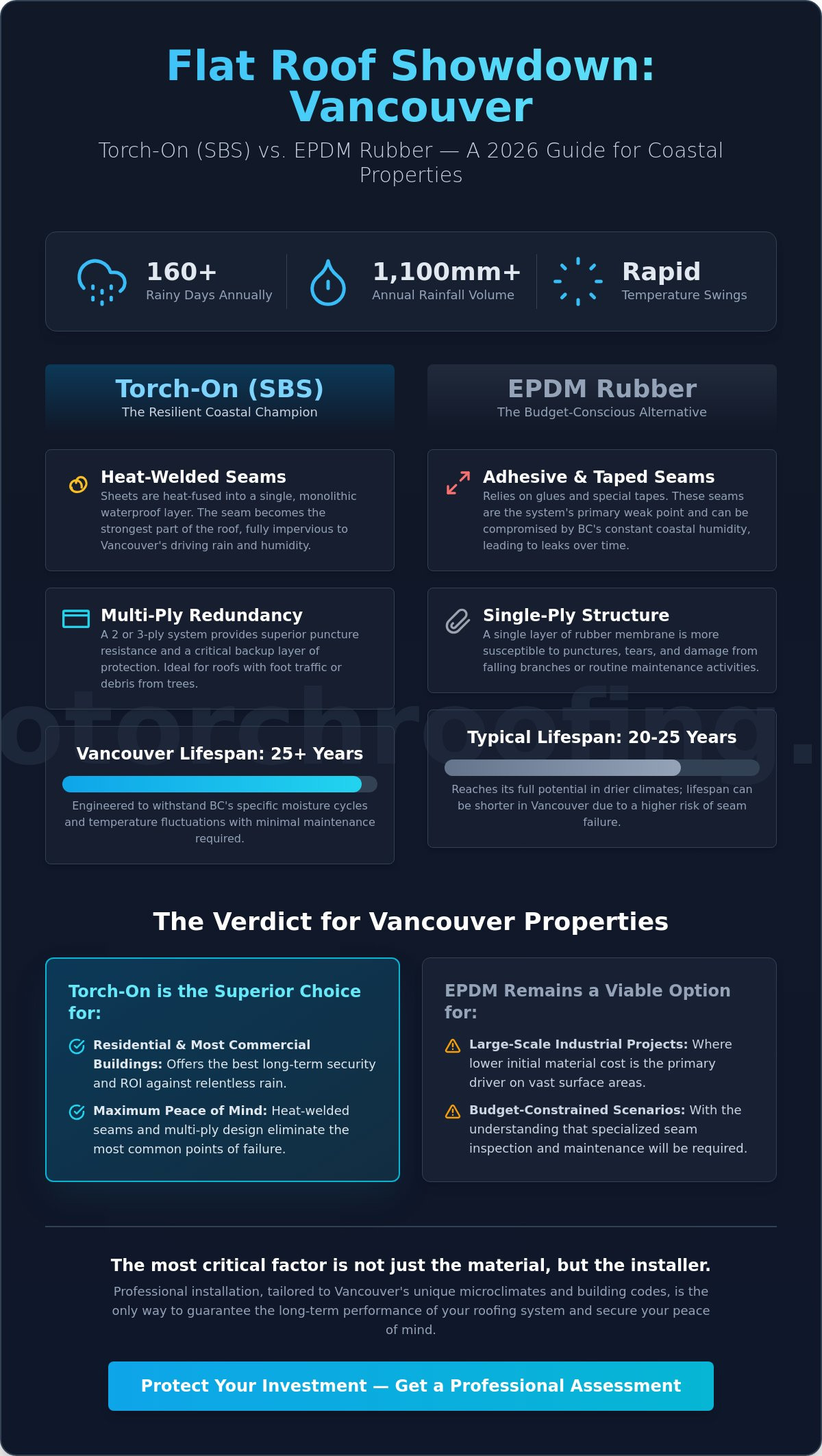
The composition of these materials dictates their performance in coastal environments. Torch-on systems utilize thick, bitumen-based layers that provide a rugged barrier. EPDM relies on a thinner, single-ply rubber sheet. While EPDM can last 20 to 25 years in drier climates, the coastal humidity and heavy rainfall of BC often favor the robust nature of torch-on.
Material Composition
Torch-on uses asphalt-based membranes; EPDM uses synthetic rubber.
Lifespan
Both systems can reach 20+ years, but torch-on often handles BC's moisture cycles with fewer maintenance requirements.
Cost Considerations
Residential projects in Vancouver typically see better long-term value from torch-on due to its durability. Large commercial properties might consider EPDM for lower initial material costs, though they must account for specialized seam maintenance in wet zones.
ProTorch Roofing focuses on providing peace of mind through craftsmanship. We ensure every installation meets the high standards required for our local climate, focusing on perimeter flashing and secure seals to protect your investment for decades.
The Case for Torch-on Roofing (SBS Membranes) in the Lower Mainland
SBS is a polymer-modified bitumen that maintains flexibility in freezing North Vancouver winters. This material, technically known as Styrene-Butadiene-Styrene, represents a significant evolution in asphalt technology. By blending high-quality bitumen with synthetic rubber polymers, manufacturers create a membrane that can expand and contract without cracking. This is vital for the Vancouver climate where temperatures can shift from 2°C to 25°C within a single week during the spring months. The primary technical reason many property owners choose torch on roofing vs EPDM Vancouver is the structural integrity of the seams.
The welded seam advantage sets torch-on systems apart from almost every other flat roofing option. Instead of relying on chemical adhesives or double-sided tapes, installers use a propane torch to melt the bitumen backing of the membrane. This fuses the sheets together into a single, monolithic waterproof barrier. These heat-fused joints are physically stronger than the membrane itself, ensuring that the most vulnerable part of a roof becomes its strongest point. In a region that experiences over 1,100mm of annual rainfall, this level of moisture protection is a necessity for long-term structural health.
Multi-ply redundancy adds another layer of security for local buildings. While some systems rely on a single sheet of material, a professional torch-on installation typically involves a 2-ply or 3-ply approach. This includes a high-tensile base sheet followed by a reinforced cap sheet. If the top layer sustains damage from a fallen branch or heavy debris during a coastal storm, the underlying layers remain intact to prevent leaks. This redundancy provides the peace of mind that Vancouver homeowners need during 100 km/h wind gusts and heavy atmospheric rivers.
Durability and Puncture Resistance
When weighing the benefits of torch on roofing vs EPDM Vancouver, the physical mass of the system is a deciding factor for long-term protection. Torch-on membranes are significantly thicker than their rubber counterparts. A standard 2-ply system measures between 7mm and 8mm in total thickness, whereas EPDM is often only 1.14mm (45 mil) thick. The ceramic granular surface of the cap sheet acts as a sacrificial shield, protecting the bitumen from UV degradation and physical impact. This robust profile is why SBS remains the preferred choice for commercial roofing in Vancouver, where rooftop equipment and maintenance traffic are common.
Installation Safety and Expertise
The "open flame" myth often causes unnecessary hesitation for property owners. Modern safety protocols have transformed the installation process into a disciplined, controlled operation. Certified installers utilize low-output torches and conduct mandatory two-hour fire watches using thermal imaging cameras to ensure the structure is completely safe after the work concludes. It requires specialized torch on roofing techniques that only experienced crews can execute properly. ProTorch Roofing brings 25+ years of local expertise to every project, backed by comprehensive insurance and a commitment to craftsmanship. If you want to ensure your building is protected for the next two decades, you should book a professional assessment to evaluate your roof's specific needs.
EPDM Rubber Roofing: Strengths and BC-Specific Weaknesses
EPDM (Ethylene Propylene Diene Monomer) is a single-ply synthetic rubber membrane frequently chosen for large-scale industrial projects. In the Vancouver market, it's often prioritized for warehouses or commercial spans exceeding 10,000 square feet because the initial material cost is lower than multi-ply systems. While it provides a budget-friendly entry point, the long-term performance of torch on roofing vs EPDM Vancouver weather conditions often tells a different story. The primary strength of EPDM is its elasticity, but this same flexibility leads to significant maintenance hurdles in our coastal environment.
Budget-Friendly
Lower upfront costs for massive industrial footprints.
Elasticity
The rubber can stretch, though this leads to shrinkage issues later.
Installation Speed
Large rolls can cover open spaces quickly in dry weather.
The Adhesive Problem
The most critical vulnerability of EPDM in British Columbia is its reliance on adhesives. Vancouver averages over 160 rainy days a year, and the high ambient humidity often exceeds 70% during peak installation seasons. Coastal moisture can easily compromise the chemical bond of EPDM glues and seam tapes. Unlike the heat-welded seams of an SBS torch-on system, EPDM seams are glued together. Over time, these seams can delaminate, leading to bubbling, peeling, or "fish-mouthing" at the corners. Once a seam fails, water travels horizontally under the rubber, making it difficult to locate the source of a leak without stripping large sections of the roof.
Environmental and Aesthetic Factors
The aesthetic and thermal impact of EPDM is a major consideration for property owners in the Lower Mainland. Most EPDM installations use a black rubber finish. During a typical Burnaby summer where ambient temperatures reach 30°C, a black EPDM surface can soar to 75°C. This extreme heat absorption places immense stress on HVAC systems and increases cooling costs. In contrast, torch-on systems offer granulated finishes that provide better UV reflection and a more polished appearance for residential neighborhoods.
We also see frequent issues with membrane shrinkage. Industry data indicates that EPDM can shrink by 2% to 3% over its life, which pulls the material away from perimeter flashing and roof drains. This mechanical stress requires frequent professional inspections to ensure the structural integrity of the building remains intact. While EPDM is a valid choice for certain industrial applications, the technical advantages of a fused SBS system generally provide better peace of mind for Vancouver's climate. If you're noticing signs of seam failure or corner lifting on your current rubber roof, it's time for a professional assessment to prevent moisture from reaching your roof deck.
Vancouver Comparison Guide: Durability, Cost, and Maintenance
When evaluating torch on roofing vs EPDM Vancouver property owners must weigh immediate savings against long-term structural integrity. A standard 2-ply SBS torch-on system typically offers a lifespan of 20 to 25 years in the Pacific Northwest. In contrast, EPDM rubber membranes often reach their limit between 15 and 20 years. This gap in longevity is largely due to how each material handles Vancouver’s unique weather patterns. While EPDM can become brittle after repeated exposure to UV rays and temperature fluctuations, the polymer-modified bitumen in torch-on systems remains flexible. This flexibility is vital during the heavy snow loads and atmospheric rivers that dropped over 100mm of rain in single 24-hour periods during recent 2024 storm cycles.
The financial profile of these systems varies significantly over two decades. EPDM requires a lower upfront investment, often costing 15% to 20% less than a professional torch-on installation. However, the multi-layer redundancy of torch-on roofing significantly reduces the frequency of emergency calls. While EPDM is cheaper initially, torch-on provides the lowest total cost of ownership in BC.
The Real Cost of Repairs
Repairing a flat roof in the Lower Mainland requires a solution that withstands constant moisture. Torch-on repairs are considered permanent because the new membrane is heat-welded to the existing layer, creating a monolithic bond. EPDM repairs rely on liquid adhesives or specialized tapes, which can peel if the surface isn't perfectly dry during application. We often see roof repair in Burnaby for EPDM systems where the seams have failed due to ponding water. To prevent these issues, we integrate custom 26-gauge sheet metal flashing around the perimeter. This hardware protects the most vulnerable points of the roof, ensuring that the transition from the deck to the wall remains watertight for the duration of the membrane's life.
Property Value and Warranty
For Vancouver homeowners and commercial managers, the choice of material directly affects resale value. Real estate inspectors in the Lower Mainland recognize 2-ply SBS torch-on as the gold standard for flat assemblies. This preference is reflected in strata council decisions; approximately 85% of multi-family buildings in Greater Vancouver opt for torch-on systems because of their proven track record. When you invest in a new roof, it's essential to distinguish between a manufacturer's material warranty and a contractor's workmanship guarantee. A robust roof maintenance plan can extend a torch-on warranty by years, providing the documentation needed to reassure future buyers of the building's health.
Don't leave your property's protection to chance. Contact ProTorch Roofing today for a professional assessment of your flat roof needs.
Professional Installation: Protecting Your Vancouver Investment
Vancouver's coastal climate is unforgiving to flat roof structures. With an average of 160 rainy days per year, a roof must be more than just waterproof; it has to be resilient against constant moisture and rapid temperature shifts. Our team understands the specific microclimates of the Lower Mainland, from the salt air in Kitsilano to the heavier snowfall often seen in Burnaby North. Pro Torch Roofing has spent over 25 years perfecting our approach to these local conditions. As a family-owned business, we prioritize the structural integrity of your property over quick turnovers.
Our assessment process involves a detailed look at your existing deck, insulation levels, and drainage capacity. We don't believe in a one-size-fits-all solution. However, when weighing the benefits of torch on roofing vs EPDM Vancouver property owners often find that the multi-ply protection of SBS membranes offers better resistance against our region's heavy debris and rainfall. We recommend torch-on systems for approximately 90% of the flat roofs we service because of their superior seam strength and longevity in wet environments.
Choosing a Local Roofing Contractor
Selecting a roofing contractor in Burnaby requires looking beyond the initial quote. It's vital to partner with a team that carries specialized flat roof liability insurance and full WCB coverage. Because torch-on installation involves open flames, safety protocols are a non-negotiable part of our daily operations. We protect your home or business with disciplined site management and rigorous quality control.
We distinguish ourselves by operating an in-house custom sheet metal shop. This facility allows us to fabricate perimeter flashing and drainage components that fit your roof's unique dimensions perfectly. A custom fit prevents the "wicking" effect where water creeps under the membrane, which is a common failure point in generic installations. This level of craftsmanship ensures that your investment remains secure for decades, not just years.
Next Steps for Your Property
Protecting your investment starts with a professional roof inspection. When you book a consultation for a flat roof replacement, we provide a deep-dive assessment. We examine the health of the underlying plywood and the efficiency of your current drainage system. Our goal is to provide a comprehensive plan that settles the torch on roofing vs EPDM Vancouver debate based on your building's specific orientation and usage.
You can expect a transparent quote that breaks down material costs, labour, and timelines. We don't use high-pressure sales tactics. Instead, we provide the technical information you need to choose the best protection for your structure. Contact Pro Torch Roofing today for a peace-of-mind assessment and ensure your property is ready for the next 25 years of West Coast weather.
Securing Your Property’s Future with the Right Flat Roof
Deciding between torch on roofing vs EPDM Vancouver requires a clear understanding of how different materials perform under the Lower Mainland's heavy annual rainfall. High-performance SBS membranes offer a multi-layered defense that handles BC's freeze-thaw cycles more effectively than single-ply rubber options. While EPDM has its place in certain climates, the superior structural integrity and 20 to 30 year lifespan of torch-on systems make them the preferred choice for 2026 and beyond. Proper installation is the only way to ensure your perimeter flashing and seams remain watertight during a typical Vancouver winter.
Pro Torch Roofing is a family-owned and operated company with deep local roots and over 25 years of experience serving the Lower Mainland. We're specialists in high-performance SBS torch-on systems, focusing on craftsmanship that provides lasting peace of mind for every property owner. Our team understands the specific technical requirements of coastal British Columbia properties and the importance of a methodical approach to waterproofing. We don't believe in high-pressure sales; we believe in providing the security your home or business deserves through transparent communication and quality work.
Get a Professional Flat Roof Assessment from Pro Torch Roofing
We look forward to helping you protect your investment with a roof built to last.
Frequently Asked Questions
Is torch-on roofing better than EPDM for Vancouver’s rain?
Torch-on roofing is generally superior for Vancouver's heavy rainfall because it utilizes a multi-layer redundancy and heat-welded seams. Unlike EPDM, which relies on adhesive tapes that can fail under constant moisture, SBS membranes create a seamless, waterproof bond. In the Lower Mainland, where annual precipitation often exceeds 1,100mm, this structural integrity is vital for preventing leaks and ensuring long-term security.
How long does a torch-on roof last in British Columbia compared to rubber?
A professionally installed 2-ply torch-on roof typically lasts 20 to 25 years in British Columbia, while EPDM often reaches 15 to 20 years before the seams require repair. The SBS membrane's ability to expand and contract during BC's temperature fluctuations prevents premature cracking. Regular maintenance can extend the lifespan of these systems, providing peace of mind and protecting the structural health of your building.
Which flat roof material is more expensive to install in Burnaby?
Torch-on roofing generally carries a higher initial installation cost in Burnaby compared to EPDM due to the specialized labor and multi-layer application process. While EPDM is faster to roll out, the superior durability of torch on roofing vs EPDM Vancouver makes it a more cost-effective choice over a 20 year period. Local building codes and permit requirements also influence the final investment for Burnaby property owners.
Can you install EPDM over an existing torch-on roof?
You shouldn't install EPDM directly over an existing torch-on roof because the asphalt oils in the SBS membrane will degrade the rubber material. This chemical incompatibility leads to rapid failure of the new system. A proper installation requires a complete tear-off or the addition of a recovery board to separate the two materials. This step is essential to maintain the craftsmanship and safety of the roof.
Is torch-on roofing a fire hazard for residential homes?
Torch-on roofing is safe for residential homes when installed by certified professionals following the RCABC safety protocols. Modern installers use fire-resistant base sheets and maintain strict fire watch periods for 2 hours after the work is complete. These industry standards, combined with specialized equipment, ensure your home remains protected throughout the process. Our disciplined approach prioritizes the safety of your property above all else.
What maintenance does a flat roof need to survive Vancouver winters?
To survive Vancouver winters, a flat roof requires a professional inspection at least twice a year to clear drains and check perimeter flashing. Debris like pine needles and leaves can trap water, leading to ponding during the 40 to 60 freeze-thaw cycles BC experiences annually. Keeping the SBS membrane clean ensures the system handles heavy snow loads and rain without compromise. This proactive care prevents small issues from becoming costly problems.
Does EPDM roofing shrink in the BC climate?
EPDM membranes are known to shrink by up to 2 percent over their lifespan, which can pull the material away from parapet walls and corners. This shrinkage often causes tension on the seams, leading to potential leaks in areas like Vancouver and Richmond. Torch-on systems don't suffer from this specific issue because the SBS bitumen is reinforced with polyester or fiberglass mats. This reinforcement provides the stability needed for the local climate.
What is the best flat roof material for a commercial building in Vancouver?
Torch-on roofing is widely considered the best choice for commercial buildings in Vancouver because it withstands heavy foot traffic and mechanical equipment better than EPDM. The 2-ply SBS system offers superior puncture resistance against fallen branches or maintenance tools. Comparing torch on roofing vs EPDM Vancouver reveals that the heat-welded seams of SBS provide the most reliable protection for high-value commercial assets and long-term structural integrity.
