

Finding a Flat Roof Leak on the Sunshine Coast: Where the Water Actually Gets In
The call usually comes in late November, after the second or third southeaster of the season. There is a brown ring on a bedroom ceiling, it was not there in October, and it is nowhere near the flat roof over the addition.
That is the normal case, not the odd one. On a pitched roof you can often work back up the slope from a stain and find the hole more or less above it. On a flat roof you cannot. Water that gets through a membrane lands on something — a layer of insulation, a vapour barrier, a plywood deck — and then travels, sometimes several metres, before it finds a way down into the room. The ceiling tells you where the water finished. It tells you very little about where it started.
This is the part of flat roofing that owners end up paying for twice: once for the repair aimed at the stain, and again for the repair aimed at the leak. What follows is the order we work in, and what you can usefully write down before anyone gets on the roof.
Key takeaways
- The stain is not the hole. Three to six metres between the entry point and the drip is ordinary on a low-slope roof.
- When it leaks is the most useful thing you can report. Every rain, only in a southeast gale, only after two days of steady rain and only during a thaw are four different faults.
- A flat roof gets checked in a set order — drains, penetrations, upstands and flashings, then the field — because that is the order in which they fail.
- Sealant fails because roofing sheds water by lapping and sealant works by blocking. A patch is a dated temporary measure, not a repair.
- Stopping the leak is half the job. Wet insulation does not dry out, and leaving it in costs you the deck.
Why the stain is nowhere near the hole
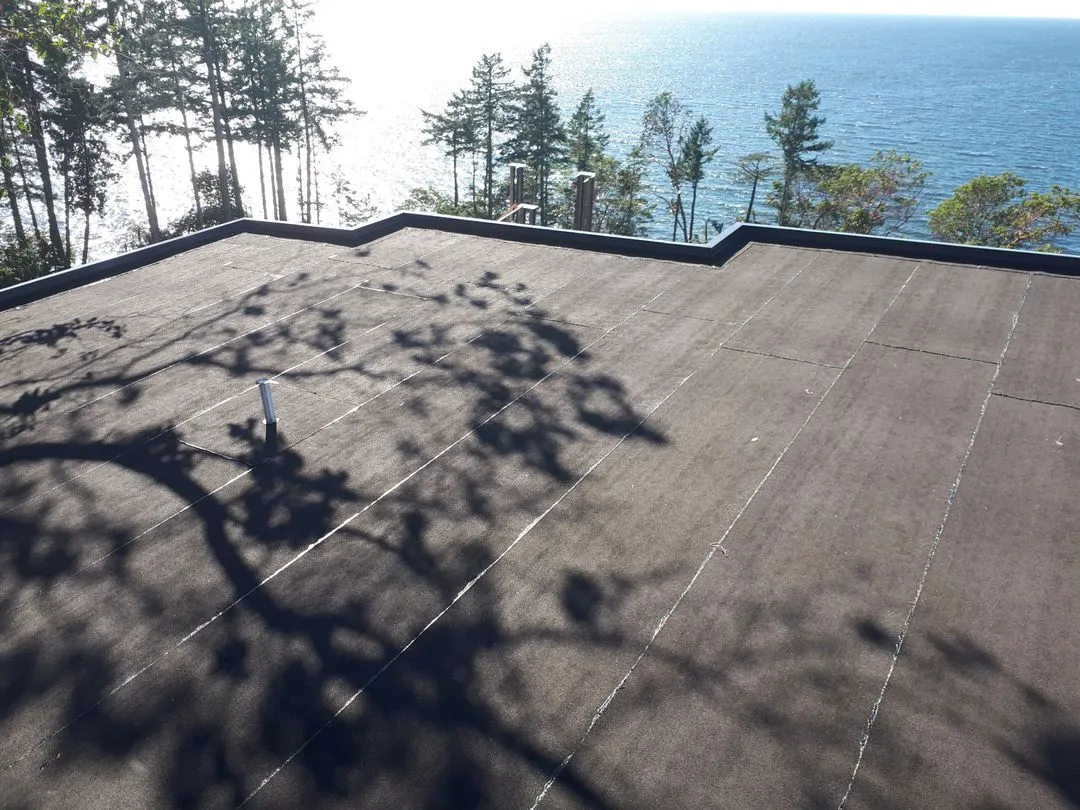
A flat roof is not flat. It is built with a fall of about two per cent toward a drain or a scupper, and between the slope, the deflection of the joists under load and whatever settling the building has done, there is a path downhill from almost any point on it. Water that gets past the membrane follows that path, not the one directly down into the room.
Where it travels depends on the assembly. Above the deck, water entering at a seam or a fastener will run along the face of the insulation board until it reaches a board joint, a fastener plate or an edge, and drop through there. Below the deck, it lands on the plywood and runs until it meets a joist, then turns and runs along the joist line — which on most houses is at right angles to the roof slope, so the water now travels sideways across the building. It falls out of the assembly at the first interruption: a strongback, a block, a recessed light housing, a bathroom fan, a duct penetration, a joint in the ceiling drywall.
That is why one of the most common conversations on a Coast flat roof goes: the leak shows over the kitchen, the hole is above the hallway, and the only reason it drips over the kitchen is that the pot light there is the lowest hole in the ceiling. Move the light and the stain moves with it.
It also explains the delay. A leak that starts during Tuesday's rain can appear on Thursday, because the water spent two days in saturated insulation before enough of it collected to come through.
What the timing of the leak tells you
Before anyone goes up a ladder, the pattern is worth more than a description of the stain. Four patterns, four different faults.
- Every time it rains, starting within an hour. There is an open path through the membrane in the field or in a low spot, usually at a seam, a puncture or a penetration that sits in standing water. The most straightforward kind to find.
- Only when it is blowing from the southeast. This is a vertical-surface leak, and on the Coast it is the common one: the gales come ahead of Pacific fronts from the southeast, and driven rain does not fall on a roof, it is pushed sideways at it. Water is getting over an upstand that is too low, behind a counterflashing, past a loose termination bar, through a door threshold onto a roof deck, or into the throat of a scupper. In still rain the same roof is dry.
- Only after a long spell of steady rain. Something is filling up before it overflows. Saturated insulation that has run out of capacity, a blocked drain backing water above the flashing line, or a dead-flat area holding water deep enough to reach a lap. November averages around 250 millimetres in Gibsons, so this one usually makes its first appearance in the same fortnight every year.
- During a thaw, or in a cold snap with no rain at all. Ice at a drain or scupper during the thaw; in the dry cold it is probably not a leak at all but condensation inside the assembly, which is a ventilation and vapour problem with a different fix.
Keep a note by the door: date, how long it had been raining, which way the wind was blowing, where it appeared first, and how long after the rain stopped it stopped. Three entries over one winter will usually narrow a roof down further than an afternoon of looking at it — and here that is the difference between a productive site visit and an exploratory one, because nobody is crossing back over the water that afternoon on a hunch.
The order a roofer checks a flat roof
Most Coast flat roofs are small: a 20 to 60 square metre section over an addition, a carport, a garage or a deck on a house that is otherwise pitched. A roof that size has almost no open field. It is nearly all edge, junction and penetration, and the inspection order follows that.
First, inside. Find the wet part of the assembly rather than the stain. Where it is accessible we look above the ceiling with a light and a moisture meter, because the shape of the wet zone is informative: a wet area running in a line along a joist tells you which way the water arrived.
Then the drains and scuppers. They fail more often than anything else on the roof and they are checked first every time: debris in the sump, a clamping ring that has worked loose, the lead or membrane flashing at the bowl, a strainer missing, the tide line of silt that shows how high the water has been standing. An overflow scupper that has never run is a good sign; one with a stain under it is telling you the primary drain is blocked.
Then every penetration. Vent stacks, plumbing stacks, mechanical curbs, rail posts, conduit, anything with a collar or a clamp. The failure is usually the sealant at the top of a collar, which was never meant to be the waterproofing.
Then the upstands and flashings. Where the roof meets a wall, a chimney, a skylight curb or a parapet. We are looking at the height of the membrane turn-up, the condition of the counterflashing and whether it is still tucked in, the termination bar and its sealant line, and the junction between the flat section and the pitched roof above it, which on a house with an addition is where two trades met and neither owned the detail.
Then the field and the edge metal. Seams probed with a blunt tool, fish-mouths at laps, blisters, splits at insulation board joints, punctures from a dropped tool or foot traffic to a satellite dish, then the drip edge and the laps between lengths of it. Ponding areas get particular attention, because a seam that is sound in dry weather can still leak after a week under 25 millimetres of water.
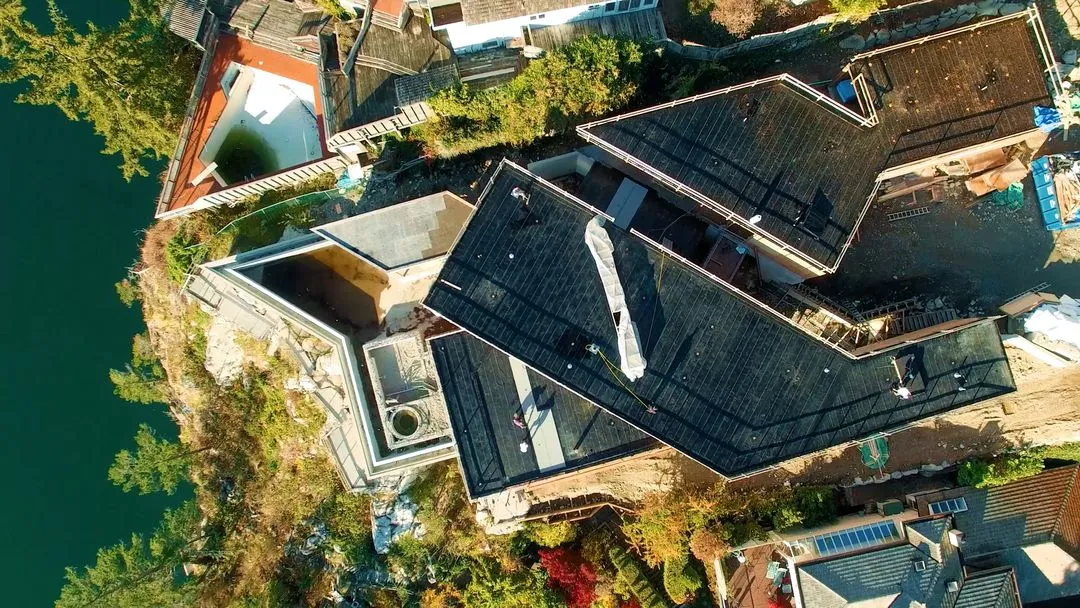
Our assessments are free and flown by drone wherever the site allows, which is how a 10 metre high flat roof gets looked at properly without a ladder on wet ground. You keep the photographs. Drone roof inspections are also the fastest way to settle an argument about whether a problem is on the roof or on the wall above it.
That argument is worth having, because a fair share of flat roof leaks are not membrane failures at all. Driven rain getting behind siding at a window head above the roof, a missing kick-out at a roof-to-wall junction, a plumbing stack leaking inside the wall, or winter condensation on the underside of a cold deck all produce a stain that looks exactly like a roof leak — and our storm season checklist covers the attic version of the condensation problem. A roofer who patches the membrane on all of them will be back in the spring.
Water testing, done in the right order
When the visual inspection gives two or three candidates rather than one answer, the next step is a water test — and the order is everything, because once a whole roof is wet you have destroyed your own evidence.
A test runs from the lowest point upward, one element at a time, with someone inside watching the wet spot and in contact with the person on the roof. Start at the bottom: wet the edge metal and the lowest few feet for ten or fifteen minutes and wait. If nothing appears, move up to the next element — the penetration, then the wall flashing, then the field above it — and repeat. Enough water to simulate rain, not a jet, and real time between stages. Running a hose over everything for five minutes proves only that the roof leaks, which you already knew.
Two things not to do. Do not water test in freezing weather. And do not flood test a roof by plugging the drain unless you are confident the deck and structure can take it: a 100 square metre roof holding 25 millimetres of water is carrying about 2,500 kilograms, which is a lot of weight to put on an assembly whose condition is the thing in question.
If the test cannot locate it and the roof is old, the next step is not more testing. It is cutting a small test opening in the suspect area, looking at the insulation and the deck, and making the repair-or-replace decision on what is actually in there — a judgement we set out in our post on torch-on roofing in Gibsons.
Why the tube of black sealant fails
Almost every older flat roof on the Coast has sealant on it somewhere: a cone around a vent, a smear along a lap, a trowelled patch over a suspected hole. Some of it is ten years old. Almost none of it is working.
The reason is mechanical, not a question of brand. Roofing sheds water by lapping: each sheet overlaps the one below so water runs over the joint and keeps going. Sealant works by blocking: a bead of material holding back water that is sitting on the joint. One relies on gravity, the other on adhesion — and adhesion has to survive a wet, dirty surface, UV, and a joint that moves every time the roof heats and cools. It is also applied in the worst possible conditions, because people patch roofs during the rain.
The second cost is diagnostic. A patch hides the evidence: the next person up there cannot see whether the lap underneath failed, or whether the previous repair was even aimed at the right place.
There is an honest use for it. Between October and April there are stretches on the Coast where there is no dry window long enough to do a proper repair, and stopping water getting into a house this week is the right call. That is a temporary measure: note the date, tell the owner what it is, and come back and do the repair properly. The failure is not the patch. It is the patch that was still there four winters later.
After the leak is found: the insulation
Finding and sealing the entry point is half the repair. The other half is what the water has been doing inside the assembly since it got in.
Water in roof insulation does not drain and does not dry. It spreads through the boards and sits between the membrane and the deck with nowhere to go. While it is in there it keeps the ceiling below damp for weeks after the roof itself is sound, which owners reasonably read as a failed repair. It cuts the insulating value of the board. It corrodes fasteners and plates. And it stays against the plywood until the deck goes soft, which turns a flashing repair into a deck replacement.
So a proper repair opens the wet area, finds the edge of it, and replaces the saturated boards before the new membrane goes down — with core cuts to confirm the extent rather than a guess. A quote that covers only the membrane patch and says nothing about what is underneath is not a comparable quote.
This is also where the arithmetic changes. One leak in a sound fifteen-year-old roof is a repair. Three leaks in two winters in different places, on a roof with wet insulation in more than one area, is a roof that is telling you something, and the repair money is better put toward replacing it.
Pro Torch Roofing is a flat-roof shop first: leak diagnosis and repair, torch-on and waterproofing across the Sunshine Coast, with 25 years and 850-plus roofs behind it and $5 million liability including hot work. If you have a stain and a pattern, the pattern is the useful half — bring it to the phone call. Our Sunshine Coast roofing page sets out what we do and where we work, or call (778) 316-1247.
