

Hiring a Roofer From Across the Water: What to Ask Before You Sign
There is usually a specific moment that sends a Coast homeowner looking for a roofer on the other side of Howe Sound. The flat section over the addition has been patched twice and it is wet again. Or three quotes came back for shingles when the actual problem is the low-slope piece at the back of the house. Or a strata council has a depreciation report asking for a membrane assessment and nobody local has offered to do one.
The next thought follows immediately. Whoever comes from the Lower Mainland has to get here on a ferry, and the repair in year three has to get here the same way.
That is a reasonable worry, and we are on the wrong end of it. Pro Torch is based in Metro Vancouver and crosses to the Coast to work. So here is the honest version of the conversation: the questions that decide whether hiring off-Coast works out, written so you can put them to us and to everyone else quoting your roof.
Key takeaways
- The ferry is a scheduling risk, not a price risk. The question that settles most of it: does the crew day-trip your job, or stay on the Coast until it is finished?
- "Watertight at the end of each working day" belongs in the contract, along with who decides to stop for weather.
- A travel line is not a red flag. An open-ended travel line is, because the number you compared is not the number you pay.
- The warranty question is not the length of the warranty. It is who physically returns for an hour of work in a February storm, and how that gets scheduled.
- Ask for the WorkSafeBC clearance letter and the insurance certificate yourself, and if any part of the roof is torch-applied, check that hot work is covered.
Why Coast homeowners phone the Lower Mainland at all
Most roofing work on the Sunshine Coast is pitched-roof work, and the companies here are built for it. That is a sensible match to the housing stock: shingles and metal on houses in Gibsons, Sechelt, Roberts Creek and on up Highway 101.
Low-slope roofing is a different trade with different equipment. Torch-applied membrane needs propane, torches, hot-work insurance and a crew that details flashings for a living. Custom flashings need a brake and somebody who can read a roof and bend metal to it rather than adapt the roof to stock profiles. Drone condition surveys need a certified pilot. None of that travels in the back of a shingle truck, which is why the flat section of a Coast house is so often the piece everybody quotes last and nobody wants.
The honest flip side: if your roof is 2,000 square feet of architectural shingles on a straightforward slope in Upper Gibsons, the right answer is probably a shop fifteen minutes away. Nobody should put a crew and a loaded trailer on a ferry for work that is available locally. The case for crossing is the work that genuinely needs the specialty — flat and low-slope sections, the pitched-to-flat transition, custom metal, strata-scale tenders and proper condition surveys.
What the ferry actually does to a roofing job
The crossing from Horseshoe Bay to Langdale is about forty minutes. The forty minutes is not the problem.
The problem is everything around it. A roofing crew does not travel light: a loaded truck, usually a trailer, propane, rolls of membrane or pallets of shingles, and a plan for the debris. All of it has to be at the terminal early enough to make a sailing, and fuel and propane travel under rules a crew needs to understand before it reaches the booth. Then add the return trip. A crew that commutes to your roof loses a serious piece of every working day to the trip, and that time sits in your price whether or not it appears on your quote.
Then there are the sailings themselves. A full boat on a long weekend in August, or a cancelled sailing in a December outflow wind coming down Howe Sound, means nobody is on your roof that day. If the crew commutes, that can happen repeatedly across one job. If the crew is already on this side of the water, it does not happen at all.
So the first question is short, and it tells you most of what you need to know. Does the crew day-trip this job, or stay on the Coast until it is finished? We book Coast work in blocks: crew, materials and equipment cross together and stay until each roof is watertight, which is also why there is no ferry premium on our quotes. Block scheduling has its own thing to ask about, so ask it — how many roofs are in the block, where does mine sit, and what happens to my start date if the roof before mine runs long.
"Watertight at the end of each working day" is the sentence that matters
A re-roof is the one renovation where the building is deliberately opened up. On the Coast the wet season runs roughly 9 October to 23 April, and November averages about 250 mm of rain at Gibsons. For half the year the question is not whether rain arrives during your job. It is what the roof looks like when it does.
Being dried in at the end of a working day means something specific, and it is worth knowing what to look for:
- Shingles: underlay fully fastened over everything stripped that day, valleys and penetrations detailed, drip edge on the runs that are open.
- Torch-on: base ply fully adhered with its laps properly heated, temporary terminations where the membrane meets walls, curbs and penetrations, and water able to find a drain rather than a low corner.
A tarp weighted down with offcuts over a stripped deck is neither of those. Ask who makes the call to stop — the foreman standing on the roof, or somebody on the mainland looking at a radar app — and ask whether that sentence is written into the contract rather than assumed. There is a practical difference here between a crew that is staying on the Coast and one that is not: the first can be back on your roof at 6 am to deal with an overnight surprise, and the second left on the evening boat.
What travel should look like on the quote
A travel line is not automatically a bad sign. An open-ended one is.
- A fixed mobilization figure you can compare between bids, rather than "ferry and travel at cost, billed on completion." The second version means the number you compared is not the number you pay.
- Disposal, named. A tear-off produces real volume, and on the Coast it either goes to a local facility or rides back across on a ferry. Somebody is paying for that. Ask which it is and whether it is in the price.
- A second mobilization clause. If the job stops partway and the crew has to come back in another block, is that charged, and who decides that the job stopped.
- A per-sheet price for deck replacement, agreed before anything is opened up. Rotten sheathing is normal on roofs of a certain age and it should never be a negotiation held while your roof is open.
Our Sunshine Coast roof cost guide has the full quote checklist and current installed price ranges for all three materials. Compare bids on the whole document, not the bottom line.
Who actually comes back in year three
There are two warranties on a roof and they fail in different ways.
The manufacturer's system warranty — ours are IKO and Soprema systems — covers the materials and, depending on the system, the assembly. It is conditional: certified installation, approved components used together, details done as specified. Ask who registers it, ask for a copy of the registration when the job is finished, and keep it with the house papers. It outlives the contractor relationship and it is what a future buyer's inspector will want to see.
The workmanship warranty is the one the water crossing tests. It is worth precisely as much as the contractor's willingness to come back over for an hour of work in a February storm. So get the mechanics in writing rather than the duration: how do I report a leak, who comes, and in the wet season what does the worst case look like. Ask whether a warranty callback depends on there being other Coast work booked that week. Ask what happens if the company stops taking Coast work.
Be sceptical of a guaranteed number here, including from us. A promised response time from a contractor who has to cross a body of water to honour it is easy to say and hard to keep. We would rather explain how our Coast scheduling actually works and write that down than quote you an hour we do not control.
Insurance, WorkSafeBC and hot work: check these yourself
Two documents, and you should hold copies rather than accept a verbal answer.
A WorkSafeBC clearance letter confirms that the contractor's account is in good standing. It exists for the benefit of whoever is hiring: without one, the person who hired the contractor can be left exposed to unpaid premiums. Ask for a current letter, or check the contractor directly with WorkSafeBC yourself.
A liability insurance certificate should name the amount, and if any part of your roof is torch-applied it should say explicitly that hot work is covered. Plenty of general policies exclude it. On a treed Coast lot, often on a well rather than a hydrant, that exclusion is the whole point of asking. Pro Torch carries $5M liability including hot work, and a certificate like that should be produced before a torch comes out of anyone's truck on your property.
One more thing an off-Coast contractor ought to get right without being prompted: which authority your address falls under. Re-roofing permit rules are not the same in the SCRD, the Town of Gibsons and the District of Sechelt, and the cost guide linked above sets out where each one stands. A contractor who works across all three should know which applies to your house before you ask.
Ask what they have actually done across water
Crossing water to work is either a habit or an experiment, and the difference shows up in the logistics rather than in the roofing.
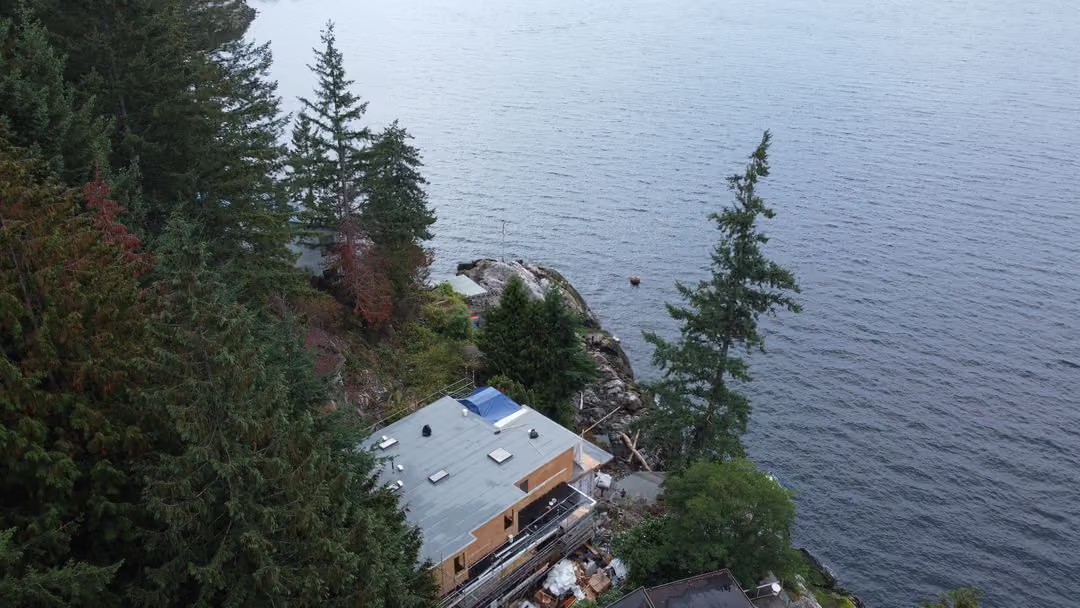
Our two honest reference points are both over water. The Kingfisher Oceanside Resort & Spa near Courtenay, in 2022: two roof areas plus maintenance, on a resort that stayed open, with every roll of membrane arriving by ferry. And Bowen Island, which has no bridge and no building-supply yard to fall back on, so everything that went onto that roof was planned before it left the shop.
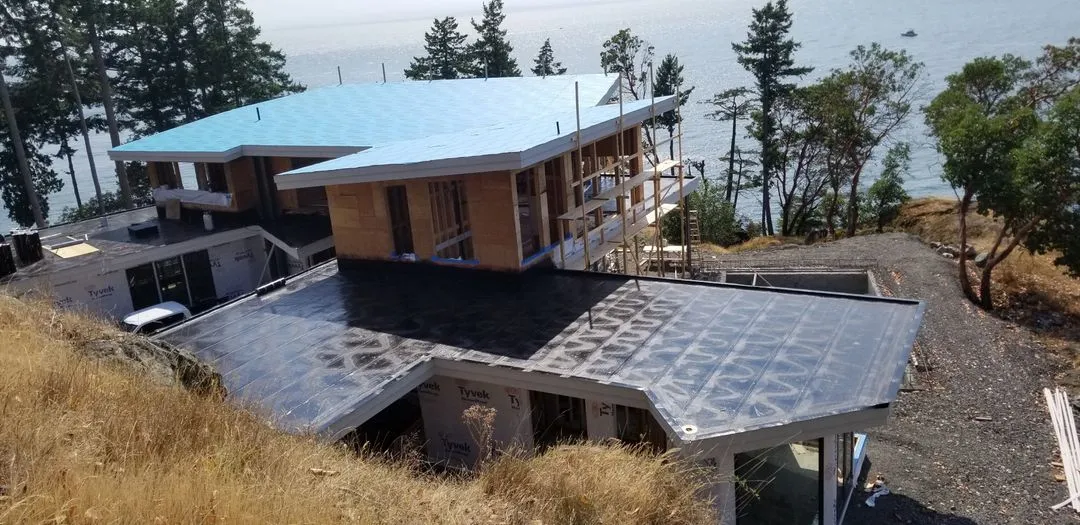
The honest part, which you should demand of any contractor including this one: Pro Torch is new to the Sunshine Coast. There are 25 years and more than 850 roofs behind us, including the Hyatt Regency Vancouver and the White Cliff project in West Vancouver, but there are no completed Coast jobs to drive you past yet. Anyone claiming a long Coast history should be asked for the street, the year, and whether you can go and look at it from the road.
The assessment is the document you both work from
When the contractor is not fifteen minutes away, the survey carries more weight than it otherwise would. It is what the quote is built on, what the scope gets argued from, and what the roof is compared against when something goes wrong later.
Ours are free and flown by drone where the site allows, by a Transport Canada Advanced RPAS certified pilot, and you keep the photographs. That last part matters for a reason beyond convenience. A dated photo set is the baseline for every later conversation, including the one where you are working out whether a stain on a ceiling is a warranty call or a new problem somewhere else. Ask for the images from anyone who assesses your roof. A contractor who will not leave you the evidence of their own assessment is telling you something useful. Drone roof inspections covers how we do it.
The short list, for reading down the phone
- Does the crew day-trip my job, or stay on the Coast until it is done?
- How many roofs are in the block, and where does mine sit in it?
- Is "watertight at the end of each working day" in the contract?
- Who decides to stop for weather, and what happens to an open deck at 4 pm?
- Is travel a fixed figure, or billed at cost afterwards?
- Is disposal included, and where does the debris actually go?
- Is a second mobilization charged if the job is interrupted?
- What is the per-sheet price if the deck needs replacing?
- Who registers the manufacturer warranty, and when do I get the paperwork?
- How do I report a leak in year three, and who comes?
- May I see the WorkSafeBC clearance letter and the insurance certificate, hot work included?
Eleven questions. Any contractor worth hiring will answer them in one phone call, and the ones who cannot are telling you in advance how the job will go.
Pro Torch Roofing is a flat-roof specialist: 25 years, 850-plus roofs, two-ply SBS systems from IKO and Soprema, our own sheet metal shop, and $5M liability including hot work. We have crossed water to work for years, and Coast work is booked in blocks with no ferry premium. Our Sunshine Coast roofing page covers the whole lower Coast, the flat-roof detail is on our torch-on roofing page, and the number is (778) 316-1247.
