

Metal Roofing in Pender Harbour and Madeira Park: What Salt Really Does
Pender Harbour is not really one harbour. It is a drowned valley with four or five arms to it, and the communities sit around the edges — Madeira Park at the head, Garden Bay and Irvines Landing further out toward the channel, houses on rock shelves with water on one side and second-growth fir on the other.
That geography does something particular to a metal roof, and it is not what open water does at Halfmoon Bay. There is less surf out here throwing salt into the air, and more shelter — and sheltered means slower to dry. A roof on an inlet takes a steady fine dose of salt and then holds it, because the wind that would have rinsed and dried the panel is broken up by the headland behind the house.
Metal is a good roof for this place. It is also the roof most often bought on the wrong specification here, because the decision gets made on profile, gauge and colour when it should be made on what the coating is and what the fasteners are made of.
Key takeaways
- On an inlet the enemy is time of wetness, not spray volume. Salt lands everywhere and only washes off the surfaces rain actually reaches.
- Coating system beats gauge. A PVDF finish over a marine-appropriate substrate, or aluminum, is the specification; basic polyester-painted steel is a false economy within sight of salt water.
- Most steel panel warranties exclude coastal exposure inside a stated distance of salt water. Ask for that number in writing before you choose the panel.
- Fasteners and flashings decide the outcome as much as the panel does. Nothing on the roof should be less corrosion-resistant than the roof, and copper anywhere above aluminum is a mistake.
- Standing seam runs roughly $12 to $20 per square foot installed, 40 to 50 years. On a part-time property the specification matters more, because nobody is there to catch the early signs.
What salt actually does on a sheltered inlet
Salt does not corrode metal by touching it. Chloride deposits on a surface and, because salt is hygroscopic, pulls moisture out of the air and holds a damp conductive film there long after the roof looks dry. Corrosion needs that film, and the longer it sits the more work it does.
So the damage on a Pender Harbour roof is uneven, and it is not where people look:
- Rain-washed surfaces do well. The open field of a panel on decent slope gets rinsed with fresh water every few days from October to April, and rinsing is the whole defence.
- Sheltered surfaces accumulate. Under a deep eave, the back of fascia metal, the underside of a drip edge, panels tucked beneath a soffit overhang or an upper deck — these never get rinsed, so every dose of salt stays and the next adds to it.
- Anything holding debris holds brine. A needle mat in a valley is a sponge keeping salt solution against the coating for months.
The job here is almost the inverse of the one inland. In Roberts Creek you are managing debris and permanent shade, covered in our post on metal roofing in Roberts Creek. Here you are managing the places fresh water never reaches.
The panel: galvanized, Galvalume or aluminum
Under the paint is a steel sheet with a metallic coating on it, and that coating is the corrosion barrier. Three realistic choices, and the price order matches the performance order.
Galvanized steel carries a zinc coating specified by weight. Zinc protects the steel sacrificially, which is why it works at all and why it is consumed faster in a chloride environment. On the Coast it is the entry level.
Galvalume is an aluminum-zinc alloy coating, roughly 55 per cent aluminum, and has been the standard coastal upgrade for decades. It lasts considerably longer than galvanized in salt air. The catch is in the paperwork: substrate warranties for coated steel commonly carve out marine exposure within a stated distance of salt water, and that distance — and whether it is measured to tidewater or the high-water line — differs between manufacturers. A great many Pender Harbour houses sit inside any such line. That does not make steel the wrong roof; it makes the exclusion a question you ask before choosing the panel rather than after a claim.
Aluminum does not rust. It forms its own tight oxide layer, stable in salt air, which is why it is the usual answer on genuinely oceanfront work. It costs more, dents more easily, and it moves: aluminum expands about twice as much as steel for the same temperature change, so panel length, clip type and expansion allowance at eave and ridge have to be worked out rather than assumed.
The paint over the top is a separate decision. PVDF, sold as Kynar 500 or Hylar 5000, holds its pigment and resists chalking, and is the finish to specify in strong light reflected off water. Silicone-modified polyester is cheaper and fine well inland; near salt it fades and chalks sooner, and chalking means the paint film is eroding rather than just looking tired.
A quote worth comparing states all of it: substrate and coating weight, paint system by name, warranty terms attached to each. "26 gauge, charcoal" tells you almost nothing about how long the roof will last here.
Fasteners, clips and the metals you bolt it together with
A standing seam roof hides its fasteners above the water plane, which is the point of it. They are still inside the assembly, in the same salt-laden air, holding the roof onto the building.
The rule is simple and often broken: nothing in the assembly should be less corrosion-resistant than the panel it holds. In marine exposure that means stainless clips and screws, and within stainless there are grades — the 316 alloys handle chloride considerably better than the common 304. Coated carbon steel screws are normal inland and the wrong economy on an inlet, because when they go you are not replacing a screw, you are opening a roof.
The other half is dissimilar metals. Put two in contact, or let one drain onto the other, add a damp salty film to carry the current, and the less noble metal corrodes at the joint. Three versions turn up on Coast houses regularly:
- Copper above aluminum or Galvalume. A copper chimney flashing or gutter upslope of the panel will pit it along the drainage path. If copper has to be there it needs isolating, or the detail needs a compatible metal.
- Pressure-treated lumber. Modern preservatives are copper-based, so panels, flashings and fasteners should not sit against fresh treated wood, and a treated deck draining onto a panel is the same problem as a copper gutter.
- Moss strips. Zinc near a ridge is sensible on a shingle roof here. Copper strips on a metal roof are not — that is installing the corrosion mechanism deliberately.
Flashings, valley metal and drip edge should come from the same family as the panel or be deliberately separated from it. We fabricate ours in our own sheet metal shop, which on a marine job is about controlling what metal ends up at every wet junction rather than accepting whatever came with the panel order.

Cut edges, filings and how panels get stored
The factory finish is the best protection the metal will ever have, and every cut made on site removes some of it. On an inlet roof the first failures are almost never in the middle of a panel. They are where it was cut, drilled or scratched during installation.
- Hemmed edges wherever the detail allows. Folding the edge back on itself puts the raw cut inside the fold instead of facing the weather.
- Shears or a nibbler, not an abrasive saw. A cut-off wheel burns the coating back from the cut line and throws hot filings that embed in the paint on landing.
- Panels swept clean at the end of every working day. Filings and drill swarf left on a panel rust in place and pit the finish around each speck. There is dew on the roof most autumn mornings here, so one night is enough.
- Dry, ventilated storage on site. A bundle left flat and wrapped in plastic traps condensation between the sheets and stains the coating before it is installed. An hour past the ferry, material often sits a day or two before it goes on.
None of this shows on a finished roof. All of it shows in year fifteen, which is the trouble with judging a metal job by how it looks the day the crew leaves.
Snap-lock or mechanically seamed
Standing seam comes two ways. Snap-lock panels have a male and female leg that click together over a clip: faster, no special tooling, and sound on a straightforward roof with decent slope. Mechanically seamed panels are folded closed over the clip by a seaming machine running the length of the panel, either a single 90 degree fold or a double 180 degree lock. That seam ends up tighter, with far more resistance to wind lifting at the leg and to water being driven into the joint.
On the outer shores here — Irvines Landing, the Agamemnon Channel side, anywhere facing down a long fetch of water — and on any slope under about 3:12, the mechanically seamed double lock with sealant in the seam is the one to buy.
Roofs nobody looks at from October to May
A large share of the housing through Pender Harbour, Garden Bay and Madeira Park is recreational or part-time. The owner closes the place in September, comes back at Easter, and in between the roof handles the entire wet season unobserved.
That is the strongest argument for metal here: it fails slowly and visibly, where the alternatives fail quietly. No granule layer to wash away, no shingle edge to lift, no sealant strip to let go in a gale. A properly specified standing seam roof on a closed-up house is doing nothing for eight months, which is what you want from it.
Two jobs still have to happen, and the owner is not there to do either:
- Clear the valleys, gutters and the uphill side of every chimney and dormer after the autumn needle drop. On a marine lot that is corrosion control, not housekeeping — debris is what keeps a salt solution against the coating.
- Rinse the sheltered metal with fresh water once a year, before the wet season. A garden hose on the fascia, the back of the edge metal, panels under deep overhangs and anything tucked beneath a deck. Not a pressure washer, which drives water into laps and under flashings.
A caretaker or a neighbour can do the list in an hour given something to look at: valleys clear, nothing wedged behind anything, no fasteners backed out on an exposed-fastener section, no organic mat against a wall on a low-slope roof, downspouts still discharging where they should. Plenty of properties here are on wells and septic, so where that water goes is not a trivial detail.
Where the owner is away, a dated set of drone photographs does the rest. Our assessments are free and flown by drone wherever the site allows, and you keep the photographs — often the only record of what the roof looked like last autumn.
Getting a crew and a flashing to Garden Bay
Pender Harbour sits roughly an hour up Highway 101 past Langdale, at the far end of the lower Coast where the highway runs on to Earls Cove. Add the crossing before that and the distance stops being a scheduling detail.
The consequence is about metal rather than driving. On a job this far out, a flashing that turns out to be the wrong length is not a half-hour trip back to the shop. So the work splits in two: everything measurable is fabricated before the block and crosses with the crew, and a brake comes along for the details the roof only reveals once the old covering is off. That is the real argument for a roofer with its own metal shop on a remote job — not the price of a flashing, but not losing two days over one. Crew, materials and equipment cross together and stay until each roof is watertight, and there is no ferry premium in our pricing. Some lots out here have no road access at all, which is a conversation to have before the quote rather than on the first morning.
What it costs, and where the metal has to stop
Standing seam runs roughly $12 to $20 per square foot installed on the Coast, with a 40 to 50 year service life. On a 1,500 square foot roof that is about $18,000 to $30,000 before GST. The full breakdown, including how cost per year of service compares with shingles, is in our Sunshine Coast roof cost guide.
Two things move a Pender Harbour job inside that range: the specification itself — aluminum, or PVDF over a better substrate with stainless fixings, sits at the upper end, and on a waterfront lot that is the version worth having — and access.
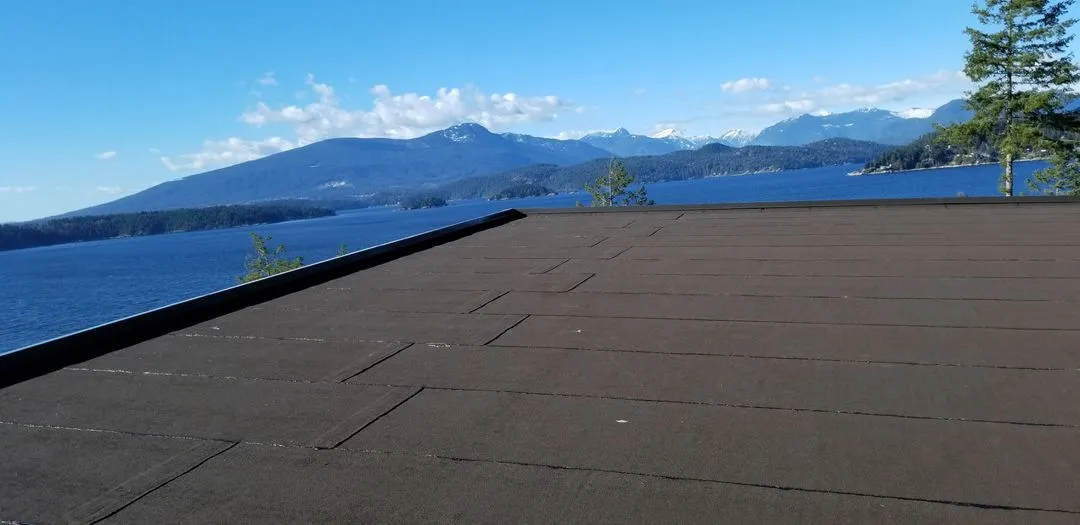
The last thing to settle is where the metal ends. Very few houses here are a clean gable — there is an entry canopy, a carport, a shed roof over an addition, or a deck above a room. Metal does not work below about a 3:12 slope, so those sections need a membrane, and the 300 millimetres where the panel terminates and the membrane begins is the part that leaks. Built properly it is one assembly: the membrane runs up under the metal with a proper upstand and the panel laps over it. We are a flat-roof shop first, so that junction gets most of our attention on a metal job.
Pro Torch Roofing installs standing seam and profiled metal roofing through Pender Harbour, Madeira Park, Garden Bay and the rest of the Sunshine Coast, and fabricates its own flashings. Twenty-five years, 850-plus roofs, $5 million liability including hot work. Our Sunshine Coast roofing page covers services and coverage, or call (778) 316-1247.
